America First Means America Alone: How the MAGA Agenda Undermines American Power
Trumpism doesn’t rebuild American power — it cannibalizes the trust that made American power possible.
Liberty’s Lens is entirely reader‑supported. We don’t answer to corporate masters deciding what we say or cover. If you find our work valuable, please consider upgrading to a paid subscription—or gifting a paid subscription to a friend who’d appreciate what we do. Thank you to every reader who shares our work and helps it reach new audiences. We love you all.
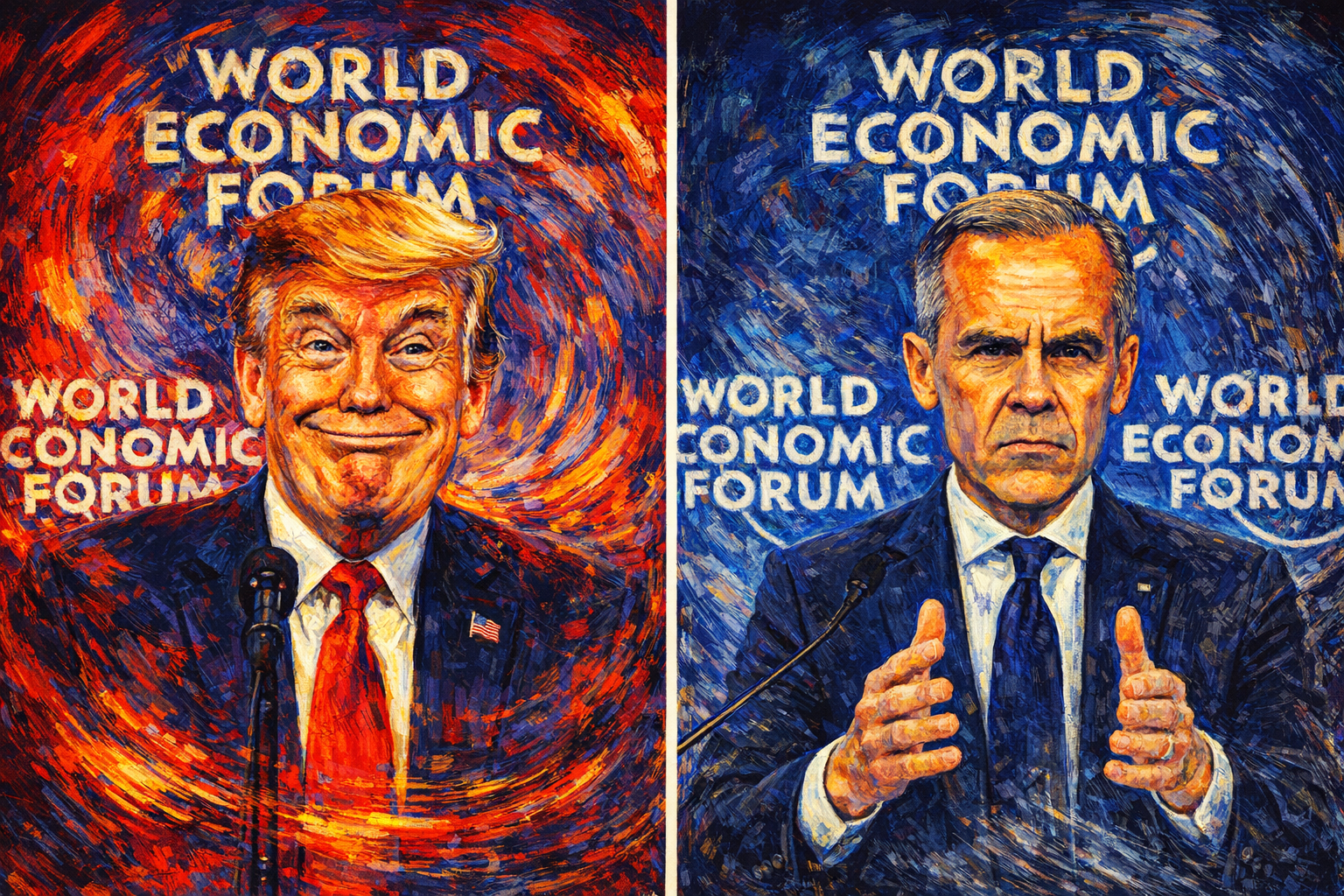
For most of the modern era, American power has looked like the obvious stuff: carrier strike groups, the world’s most advanced military‑industrial base, a sprawling intelligence apparatus, and a currency that anchors global finance. But the more important part, what actually makes the rest of it tick, has always been credibility.
The United States built the post‑World War II order on a proposition that felt stable enough for other countries to bet their futures on it: if you integrated your economy, your banks, your technology, and your security into an American-led system, the United States would not use its unrivaled leverage capriciously. Not never. Not perfectly. But with enough restraint that the bargain still made sense.
That restraint wasn’t altruism. It was strategy.
And now we are watching what happens when the United States begins to behave as if that restraint were optional, and the benefits were a given. This is the inevitable consequence of electing an aging narcissist with a dwindling capacity for self‑control consistent with his deteriorating mental faculties.
One of the central conceits of MAGA Trumpism is this: Trump may not be the Christian ideal; he may not be moral; he may even be openly corrupt — but his so‑called America First agenda will “Make America Great Again.” But is that true? His supporters are asked—explicitly—to overlook Trump’s accelerating authoritarianism under Vought’s guidance, his violations of the Constitution, the open graft, the ethno‑nationalism driving Miller’s agenda, and the wealth‑serving policies favored by oligarchic patrons like Musk. They overlook all of it because they genuinely believe his anti‑globalist theatrics are good for the country, even as the actual benefits accrue only to him and his inner circle.
When Canadian Prime Minister Mark Carney addressed the World Economic Forum in Davos on January 20, 2026, he delivered a speech that reads like a warning flare from a close ally who believes the old bargain is failing—or has already failed. The defining line is the one he repeats with unmistakable finality:
“The old order is not coming back.” (CBC)
That is not the language of a momentary dispute. It is the language of a strategic reassessment.
Our thesis here, dear readers, is simple: “America First” is not a plan to make America strong. It is a plan that leaves America alone and vulnerable. It takes the trust the United States accumulated over generations and treats it like a bank account to be drained, quickly, without understanding that the trust is the asset. Once it’s gone, it doesn’t come back on demand.
I. The “pleasant fiction” that made the world rich—and America richer
I suspect that this year’s events at Davos will prove to be a watershed moment. For many of the business leaders and political figures gathered there, this was their first unfiltered exposure to what Americans have been living with for years: the full, undiluted reality of Trump’s derangement. Americans have had no choice but to marinate in it—the insults, the racist memes, the authoritarian aesthetic, the obsessive airing of grudges. But outside the United States, many influential figures have been spared the worst of it. They haven’t been watching Trump post grotesque images of the Obamas’ heads on the bodies of apes, or videos of himself as a monarch showering excrement on American protesters. They haven’t had to live inside it.
This year, they had to. And the effect was clarifying.
Besides the dawning realization that Trump is fundamentally unwell, there was Carney’s speech—revelatory for entirely different reasons, and far more consequential.
Carney’s speech begins with a cold diagnosis of the era we’ve entered:
“Every day we’re reminded that we live in an era of great power rivalry—that the rules-based order is fading, that the strong can do what they can, and the weak must suffer what they must.” (WEF transcript | Global News transcript)
He then adds something even more unsettling: the rules‑based order was never fully true. It was, in his words, a “pleasant fiction”—a fiction that stabilized the world and disproportionately benefited the United States—and that fiction is ending.
Carney makes the break explicit:
“Today I will talk about a rupture in the world order, the end of a pleasant fiction and the beginning of a harsh reality, where geopolitics, where the large, main power, geopolitics, is submitted to no limits, no constraints.
This fiction was useful, and American hegemony, in particular, helped provide public goods, open sea lanes, a stable financial system, collective security and support for frameworks for resolving disputes.” (WEF transcript | Global News transcript)
That phrasing matters because it rejects two comforting myths at once:
- The myth that the old order was pure.
- The myth that the old order was useless.
The post‑1945 system produced a historically rare stretch of stability and growth across much of the Western alliance structure. It was anchored by formal institutions and treaties—financial, diplomatic, and military.
The financial architecture
In July 1944, delegates from 44 nations met in Bretton Woods, New Hampshire to forge a cooperative monetary system and create what became the International Monetary Fund and the World Bank.
That system was explicitly designed to avoid the interwar spiral of competitive devaluations, protectionism, and breakdowns in cooperation that worsened the Great Depression. (Federal Reserve History | World Bank archive)
Bretton Woods eventually ended, but the broader reality it entrenched remained: the United States sat at the center of the global monetary ecosystem.
The security architecture
In April 1949, NATO formed around a core promise: collective defense. NATO’s own explainer describes Article 5 as its “most fundamental principle,” and the text’s meaning is blunt: an armed attack on one member is considered an attack on all.
That credibility—especially the expectation of American military backing—became one of the most powerful deterrents in modern history, the backbone of a transatlantic alliance that let Europe rebuild without re-creating independent militaries scaled to fight the Soviet Union alone. (NATO)
The reconstruction and legitimacy architecture
And then there was the Marshall Plan: in 1948, Congress passed the European Recovery Act, appropriating $13.3 billion over four years to help rebuild Western Europe. The National Archives’ official “Milestone Documents” summary explains the intent clearly: reconstruct Europe, stabilize democratic governance, and create reliable economic partners and markets. (National Archives)
The United States didn’t do this out of pure benevolence. It did it because a stable, prosperous allied world was good for American security and American business.
This, and so much else built across those decades, was the “pleasant fiction” in action: an order that restrained raw coercion, replaced it with rules and institutions, and gave countries confidence that integration would not become a trap.
II. The hidden engine of hegemony: restraint and predictability
Power does not function the same way when everyone is afraid of you. Coercion can get you compliance—but it cannot buy you durable trust. And trust is what makes an international system cheap to run.
Carney’s speech frames the psychological mechanics of dependency with a dissident’s story: Václav Havel’s parable of the greengrocer who puts up a propaganda slogan to avoid trouble. Carney’s point is not only about authoritarianism—it’s about how systems persist through ritual compliance even when belief fades.
“The system’s power comes not from its truth, but from everyone’s willingness to perform as if it were true.” (Global News)
And crucially:
“Its fragility comes from the same source.” (Global News)
For decades, America benefited from the world performing the rituals of American leadership—treating U.S. commitments as credible, U.S. institutions as reliable, and U.S. stewardship as fundamentally stabilizing. When the United States said it was acting to protect democracy (or markets, or global stability), nations acted as if those explanations were grounded in principle. They may have harbored private doubts. They may have recognized the asymmetry. But they played their part because the system still worked, and because American power still appeared bounded by norms.
We acted in self‑interest, but not only in self‑interest—and everyone else behaved as though that distinction still meant something.
But under Trump, America no longer performs virtue; we perform vice.
What once looked like principled restraint now looks like naked impulse, and the world is adjusting accordingly.
And so, Carney warns against the idea that compliance will buy safety:
“There is a strong tendency for countries to go along to get along… to hope that compliance will buy safety. Well, it won’t.” (WEF transcript)
That’s a warning to allies: don’t assume the old bargain still protects you.
It’s also a warning to the United States: if your partners stop performing the rituals, the system cracks. The fiction collapses the moment the world stops pretending it still believes us. And once the performance ends, so does the power.
III. “America First” is extraction disguised as patriotism
If the old order depended on restraint, “America First” is the abandonment of that restraint. It is a worldview that treats relationships—alliances, trade, finance—as things to be monetized, rather than systems to be sustained.
Carney’s framing is that we are entering a period where geopolitics among great powers is “submitted to no limits, no constraints.” (WEF transcript)
And he describes the shift as an abrupt break:
“We are in the midst of a rupture… the end of a pleasant fiction and the beginning of a harsh reality.” (WEF transcript)
A rupture is what happens when a leader assumes:
- he can threaten allies without cost
- he can treat trade as punishment
- he can treat military commitments as leverage to be monetized
- and he can treat the global system as a tool for self-enrichment
The point isn’t that negotiations are immoral. The point is that the method undermines the asset.
If America signals that every relationship is transactional, every ally must begin acting like an insurer: pricing risk, hedging exposure, diversifying dependence. And when allies hedge, they create alternative arrangements—financial, military, industrial—that are not easily reversed.
That is how hegemons become ordinary powers.
IV. The “plumbing” of power: finance, sanctions, and why the world builds exit ramps
The simplest way to understand why “America First” becomes “America alone” is to understand where U.S. power really lives. It’s not only in weapons. It’s in infrastructure—especially financial infrastructure.