From Free Markets to Government Checks
How Rural America’s Loyalty to Trump Turned Tariffs into a Permanent Subsidy Machine
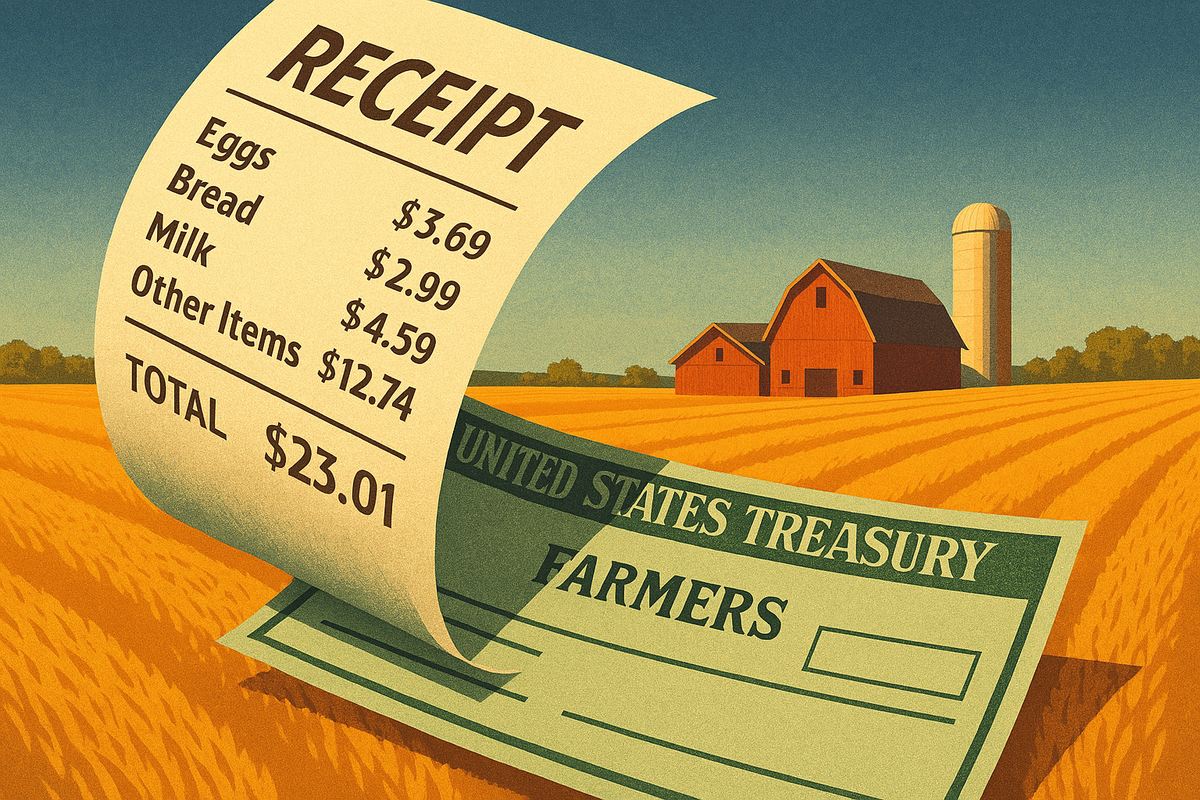
Donald Trump promised that tariffs would make American farmers rich. What they got instead—again—were government checks. In 2018–2020, retaliatory tariffs slammed U.S. farm exports and Washington rushed to pay out record aid. Now the White House is preparing to do it again, this time by tapping tariff revenues directly to fund a new round of relief (POLITICO | Roll Call).
Here’s the part the spin skips: tariffs are a tax. They raise prices for U.S. consumers and firms—and then the proceeds get recycled into checks for a politically loyal bloc. That’s a wealth transfer from the middle class paying higher prices to farmers receiving bailout cash, dressed up as “America First.” Empirically, the 2018–2019 tariff shock passed through almost dollar‑for‑dollar into domestic prices borne by U.S. consumers and importers (NBER | NY Fed).
II. The Last Time We Wrote This Story (2018–2020)
When Trump launched the first trade war, China retaliated hardest on agriculture—especially soybeans—blowing a hole in farm incomes. The administration answered with the Market Facilitation Program: $12 billion in 2018 and $16 billion in 2019, with additional pandemic‑era support pushing farm aid to historic levels (Overview | POLITICO 2020).
Who paid? Despite the talking point that “China pays,” roughly 92% of trade‑war tariff proceeds had been paid back out to farmers by late 2020—an almost direct pass‑through from tariff‑taxed businesses and consumers to bailout recipients (Council on Foreign Relations). Distribution skewed big: the largest operations captured an outsized share of subsidies, with the top 1% of recipients taking nearly a quarter of payments (Farm Progress / EWG).
Who Really Paid Last Time?
The 2018–2019 farm bailouts weren’t funded by tariff revenue. Instead, they were financed through the Commodity Credit Corporation (CCC), a government-owned entity with a $30 billion annual borrowing authority from the U.S. Treasury. This allowed the USDA to issue payments without waiting for new legislation. Tariff revenue went into the general fund and played no direct role. So when Trump said “China paid,” the reality was U.S. taxpayers—via Treasury borrowing—footed the bill. The current 2025 plan to use tariff revenue for bailouts would require new congressional authorization, marking a significant shift in funding strategy.
III. Why Farmers Are Hurting—Again
Tariff Round Two is replaying the same script: higher input costs on steel, machinery, and chemicals, paired with fresh retaliation abroad that prices U.S. crops out of key markets. China’s tariff wall has again tilted soybean demand toward Brazil, while the domestic farm economy faces squeezed margins (MSN/Fortune). And the evidence from 2018–2019 remains intact: tariff hikes passed through one‑for‑one into U.S. import prices and lifted domestic prices, with low‑ and middle‑income households disproportionately exposed (NBER | Kansas City Fed).
IV. The Forgotten Subsidy: USAID as a Lifeline
USAID wasn’t just foreign aid; it was a guaranteed buyer of U.S. crops. Through programs like Food for Peace (PL‑480) and Food for Progress, the U.S. government purchased American‑grown wheat, sorghum, rice, pulses, and vegetable oil for humanitarian relief. In a typical recent year, USAID purchased roughly $2 billion in U.S. commodities; in FY2023, the agency acquired about 1.1 million metric tons for distribution in 35 countries (DTN | AgWeb | State Dept. Historian | Food for Peace (PL‑480)).
This wasn’t charity; it was soft‑power farm policy. USAID purchases absorbed surpluses, stabilized prices, and built future customers. Japan and South Korea are textbook cases: both began as food‑aid recipients and matured into reliable buyers of U.S. wheat and other staples (NPR/WWNO | USDA FAS (archive)).
V. The Collapse: When That Market Disappears
In early 2025, the administration froze and then began dismantling USAID—terminating thousands of grants and contracts and shifting or pausing core food‑aid functions. Courts have allowed key foreign‑aid funds to be withheld while litigation proceeds (with a Supreme Court stay in late September), and major program portfolios have been canceled or stalled (POLITICO | USA Today/MSN | CSIS).
The fallout at home has been immediate. Pawnee County, Kansas, reports 1.5 million bushels of unsold sorghum in storage with traditional buyers gone. Industry groups stress that USAID’s commodity procurement—about $2 billion of U.S. food purchases in 2020 alone—has been crucial for price support and rural cash flow (AgWeb | NPR/WWNO | World‑Grain).
Bottom line: we removed a soft‑subsidy that paid farmers to feed the world—and replaced it with a hard tax (tariffs) that raises consumer prices so we can cut bailout checks at home.
VI. The New Plan: Raid the Tariff Till
Trump now says he’ll use tariff revenue for direct farm bailouts, with the administration seeking a legislative vehicle—pushing cash out in early 2026 if authorized (POLITICO | Farm Policy News). There’s a legal cloud: the Supreme Court will review the president’s tariff authority this fall (Roll Call).
The Tax Foundation estimates current tariffs would add about $171.7 billion to federal revenue in 2025—if they survive court scrutiny (Roll Call | Tax Foundation).
Let’s be clear: this isn’t free money. Tariffs act as a tax on imported goods, which means higher prices for middle‑class Americans. Those dollars are now being funneled into checks for farmers—many in counties that voted overwhelmingly for Trump—creating a wealth transfer from suburban residents to rural farmers (NBER | CFR | Ballotpedia).
Policy mechanics note: some officials have floated Section 32, a Depression‑era fund financed by 30% of customs receipts, historically used to buy surplus commodities and support child nutrition programs. But its discretionary uses are constrained and most funds are already obligated (CRS).
VII. “Voting for the Check”: The Politics of Dependency
Trump’s coalition is anchored in small‑town and rural counties—thousands of them—while Democrats consolidate in a handful of high‑output metros. In 2024, Trump won about 2,633 counties (~86% of all counties) representing roughly 38% of GDP, reinforcing the rural tilt of his base (Brookings). County‑level continuity is striking: roughly 2,559 counties voted Trump in 2016, 2020, and 2024; only 421 consistently backed the Democratic nominee—evidence of a durable rural alignment (Ballotpedia). Validated voter studies show Republicans retained a sizable rural advantage in 2024 (Pew Research).
So we arrive at an uncomfortable truth: voters in farm‑heavy counties backed a president whose trade policy repeatedly necessitates bailouts—and are poised to receive more checks paid for by everyone else. That’s not “free markets.” It’s taxation and redistribution with a rural accent (CFR | NBER).
VIII. What’s at Stake (Beyond This Harvest)
Short term, cash keeps notes current and small towns alive. But bailouts don’t rebuild customer trust in Shanghai or Rotterdam. They entrench a risky norm: tariffs as a permanent tax whose proceeds are recycled into sector‑specific subsidies—historically skewed toward the largest operations—while households absorb higher prices (Farm Progress / EWG | St. Louis Fed).
IX. The Way Out
If the goal is prosperity—not just survival—farm policy should prioritize stable market access and targeted risk management over headline‑ready rescue checks. That means de‑escalating tariff wars that shrink export demand, modernizing safety‑net tools, restoring a functioning food‑aid/export bridge, and aiming aid at genuine need and resilience rather than political optics (Roll Call | POLITICO | World‑Grain).
For readers who want the receipts
- 2018–2020 bailout totals, context, oversight concerns — (POLITICO)
- Overview of Trump‑era farm bailouts (program years, caps) — (Wikipedia)
- Who paid the tariffs; bailout consumed tariff proceeds — (Council on Foreign Relations)
- Tariff incidence on U.S. consumers/importers; price pass‑through — (NBER | NY Fed | Kansas City Fed)
- Distribution skew toward largest farms — (Farm Progress / EWG)
- 2025 plan to use tariff revenue; timeline and mechanics — (POLITICO | Farm Policy News | Roll Call)
- Projected tariff revenues in 2025 (if legal) — (Roll Call | Tax Foundation)
- Input‑cost shock/retaliation under current tariffs — (MSN/Fortune)
- USAID as a U.S. farm buyer; typical annual purchases — (DTN | NPR/WWNO)
- FY2023 USAID volume (~1.1 MMT) and rural impacts — (AgWeb)
- Food for Peace / PL‑480 history and purpose — (State Dept. Historian | Food for Peace (PL‑480) | USDA FAS (archive))
- USAID dismantling; scope of cuts; litigation posture — (POLITICO | CSIS | USA Today/MSN)
- Section 32 constraints and structure — (CRS)
- County/GDP split and rural voting continuity — (Brookings | Ballotpedia | Pew Research)
- Tariff shock lessons and import substitution dynamics — (St. Louis Fed)
— Liberty’s Lens
This article is provided for public interest reporting and analysis. All external links open in a new tab and point to their original publishers.