From Tragedy to Tyranny: How Trump Is Using Charlie Kirk’s Death to Cement Power
The week ABC benched Jimmy Kimmel Live! “indefinitely” wasn’t a taste dispute. It was a power story.
A president targeted a critic. A federal regulator with direct leverage over broadcast licenses publicly threatened “remedies.” Two giant affiliate groups preempted the show within hours, and ABC followed — while the companies involved had billions in deals and licenses pending before those same regulators. Below is the full record — quotes, timeline, leverage points, legal guideposts — and the adjacent push to consolidate narrative control through lawsuits and platform capture (TikTok and X).
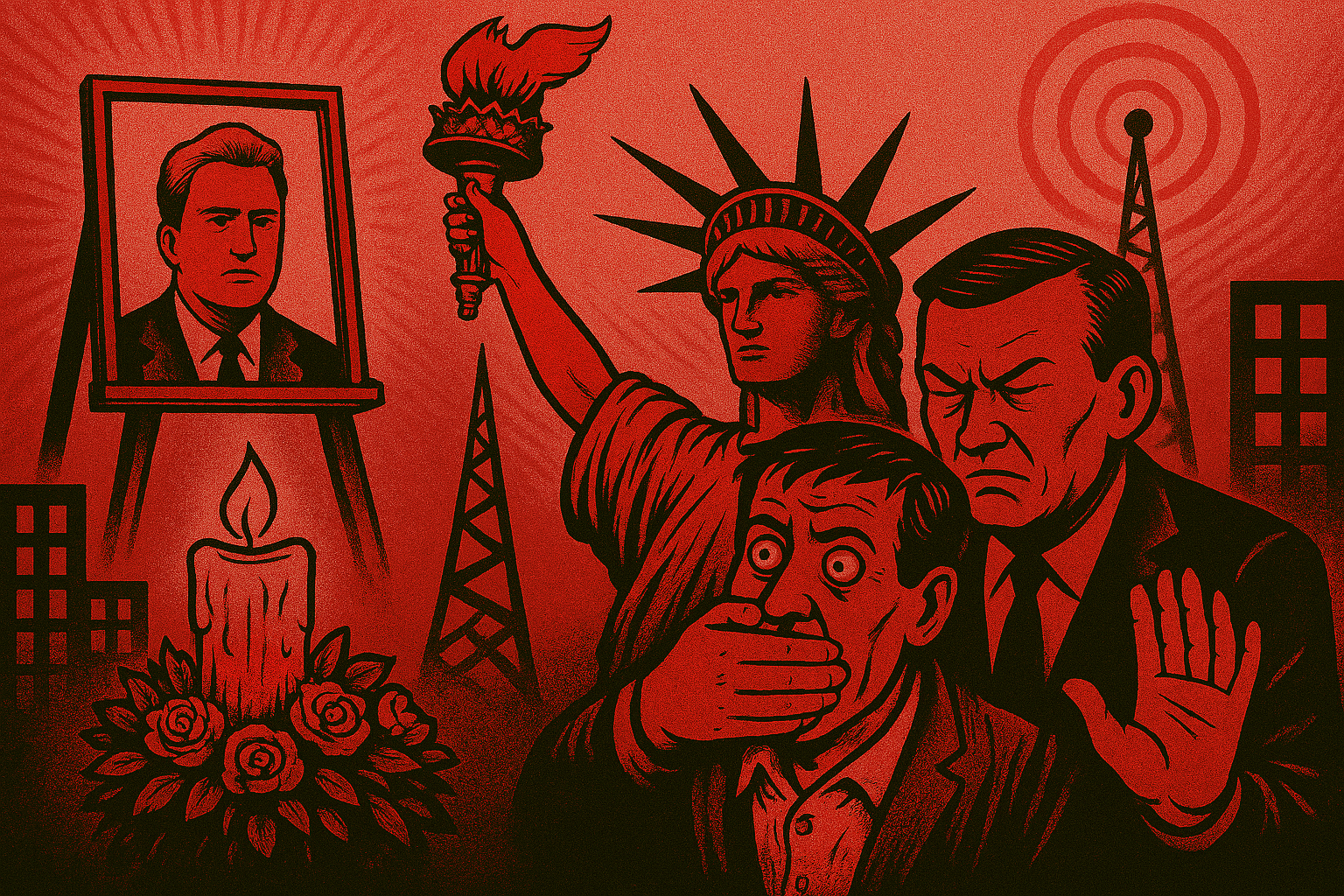
I) The pivot: from grief to power plays
In the immediate aftermath of Charlie Kirk’s assassination, senior officials moved beyond condemnation to promises of sweeping action to suppress speech, especially political dissent.
“The radicals on the left are the problem… My administration will find each and every one of those who contributed… including the organizations that fund it and support it” — Donald J Trump
Vice President J.D. Vance vowed to “go after the NGO network that foments, facilitates and engages in violence,” and senior adviser Stephen Miller pledged to "identify, disrupt, dismantle and destroy" left‑leaning networks "in Charlie’s name." ( CBC | U.S. News/Reuters )
Let’s be clear: Charlie Kirk’s killer acted alone, with no network and no funding. But Trump, J.D. “They’re eating the cats, they’re eating the dogs” Vance, and their shrill-voiced enforcer are spinning a conspiracy out of thin air — inventing a shadowy left-wing network to justify a crackdown on political opponents and their donors. It’s a terrifying move. This is how authoritarians like Orbán in Hungary built one-party regimes, where loyalty and cronyism are the only paths to survival.
Attorney General Pam Bondi is seeking to turn rhetoric into policy, framing the moment as a speech crackdown — “there’s free speech and then there’s hate speech” — language the Supreme Court has never recognized.
"There’s free speech and then there’s hate speech, and there is no place, especially now, especially after what happened to Charlie, in our society," Bondi said. "We will absolutely target you, go after you, if you are targeting anyone with hate speech."
Bondi’s statements drew bipartisan pushback, including from conservative commentators who warned that leveraging the murder to police speech would backfire. ( The Independent | Mediaite )
“You hope Charlie Kirk’s death won’t be used… to bring hate speech laws to this country.” — Tucker Carlson, adding that if it happened there would be “never a more justified moment for civil disobedience.” ( PEOPLE | Newsweek )
“And trust me, if it is, if that does happen, there is never a more justified moment for civil disobedience than that, ever. And there never will be,” Carlson added. “Because if they can tell you what to say, they're telling you what to think...There is nothing they can't do to you because they don't consider you human.”
Trump didn’t flinch in the face of pushback. Instead of urging calm or unity after a political assassination, he leaned in — embracing Pam Bondi’s threats and sharpening them into a promise to pursue his rivals with the full weight of the state.
"What do you make of Pam Bondi saying she’s going to go after hate speech? Is that, I mean, a lot of people, a lot of your allies, say hate speech is free speech." - ABC News correspondent Jonathan Karl
"She’ll probably go after people like you, because you treat me so unfairly," Trump replied, speaking over Karl as he asked if that would be appropriate. "You have a lot of hate in your heart. Maybe they will come after ABC. ABC paid me $16 million recently for a form of hate speech. Your company paid me $16 million for a form of hate speech, so maybe they will have to go after you." - Donald J Trump
This isn’t about a principled belief that certain speech is dangerous. It’s not ideology — it’s opportunism. The same MAGA voices now cheering censorship have long claimed to champion free speech, at least when it served their side. Just months ago, J.D. Vance was defending the speech rights of Germany’s far-right AfD, a party steeped in Nazi echoes. That version of Vance — the one invoking liberty abroad — sounds nothing like the one now weaponizing tragedy to silence dissent at home. (NBC)
“It’s one thing to say that a particular set of views is gross ... or somehow outside the Overton window, outside the bounds of reasonable discourse,” Vance said. “I think that it is very, very dangerous to use the neutral institutions of state — the military, the police forces ... the intel services — to try to delegitimize another competing political party.”
II) Case study — how Jimmy Kimmel Live! was taken off the air
So how is this playing out in real time? Just look at the sudden suspension of Jimmy Kimmel. The president’s son and others rushed to frame it as a routine business decision — a network simply exercising its right to drop a host who crossed a line. But that spin collapses under scrutiny.
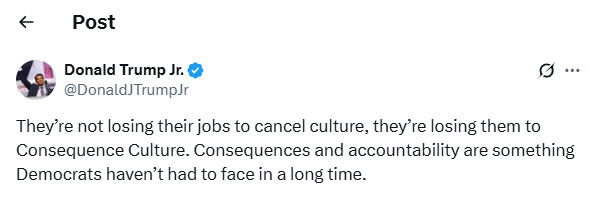
The same voices who once railed against “cancel culture” now embrace it, so long as the target is a critic. This wasn’t accountability — it was state-backed retaliation dressed up as corporate discretion.
The chain of events isn’t subtle. Trump publicly called for Kimmel’s firing, FCC Chair Brendan Carr issued thinly veiled threats, and within days, Kimmel was off the air. The throughline is clear — and chilling.
A. Target acquired (July)
“I absolutely love that Colbert got fired… I hear Jimmy Kimmel is next. Has even less talent than Colbert!”
B. The monologue (Sept. 15)
Kimmel condemned the killing and mocked the President’s response; he also said “the MAGA gang” was trying to portray the shooter as anything other than one of them — a claim conservatives blasted. ( CNBC )
C. The arm twist (Sept. 17, daytime)
“We can do this the easy way or the hard way. These companies can find ways to change conduct and take action, frankly, on Kimmel, or there’s going to be additional work for the FCC ahead.”
— FCC Chair Brendan Carr ( Variety )
“What people don’t understand is that the broadcasters … have a license granted by us at the FCC, and that comes with it an obligation to operate in the public interest.”
— Carr on Fox ( Fox News )
“You could certainly see a path forward for a suspension over this… the FCC is going to have remedies.”
— Carr ( MSN/THR )
“It’s past time [licensed broadcasters] push back on … Disney, and say, ‘We are going to preempt — we are not going to run Kimmel anymore…,’ or face fines/license revocation for a pattern of ‘news distortion.’”
— Carr ( MSN/THR )
Quick aside: “We can do this the easy way or the hard way” isn’t just a threat — it’s a line straight out of a mob movie. And frankly, it fits. These officials aren’t just flexing power; they’re acting like cartoon villains with real-world consequences. We’ll dig deeper into this in a future piece, including Trump’s border czar Tom Homan — caught on video accepting a literal bag of cash in a sting operation. You couldn’t script this if you tried.
D. The cascade (Sept. 17, afternoon & evening)
Nexstar and Sinclair — the two biggest ABC affiliate operators — announce they will preempt Kimmel “for the foreseeable future.” Hours later, ABC says the show is “pre‑empted indefinitely.” ( Deadline | CNBC )
E. The victory lap (early Sept. 18)
“Great News for America: The ratings challenged Jimmy Kimmel Show is CANCELLED. Congratulations to ABC… That leaves Jimmy and Seth, two total losers, on Fake News NBC. Their ratings are also horrible. Do it NBC!!!” President DJT
( The Hollywood Reporter | USA Today )
III) Why the threats landed — follow the leverage
1) Licenses: the broadcast choke point
Carr knew just where to push with his his threats. Station licenses are existential; lose them and the signal goes dark. By invoking “public interest,” “news distortion,” and “remedies,” the regulator aimed at the one lever affiliates cannot ignore. ( PolitiFact | Variety )
2) Nexstar–TEGNA: a $6.2B deal before the FCC / Sinclair’s Consent Decree
While Nexstar was leading the charge to preempt Kimmel, it was also filing for a $6.2 billion merger with TEGNA—a deal that can only go through if the FCC and antitrust regulators approve, and if the FCC relaxes the national ownership cap. The current rule limits any broadcaster to reaching just 39% of U.S. TV households; Nexstar’s merger would push that to about 80%. In other words, Nexstar needs not just approval, but a regulatory exemption—something FCC Chair Carr has signaled he’s open to. This is market consolidation on a massive scale, and it’s happening as Nexstar demonstrates political compliance with the Trump administration’s demands. ( TheWrap | Virginia Business | Poynter )
Sinclair, meanwhile, had more straightforward business before the FCC: buying and selling stations, which all require FCC approval for license transfers. Sinclair has also been lobbying to eliminate the 39% cap, arguing that broadcast regulations put them at a disadvantage compared to tech giants. Notably, in June, Carr’s FCC entered into a Consent Decree with Sinclair, reducing a proposed $2.652 million penalty to just $500,000 and clearing a backlog of license renewals—classic docket-cleaning before future transactions. (Communications Daily | NCS | FCC)
3) Disney’s exposure: the ESPN–NFL media deal
Disney had just unveiled a framework to acquire the NFL Network and other NFL media assets while the league takes a 10% stake in ESPN — a headline deal under regulatory microscopes, coinciding with affiliate station license risks. ( CNBC | Disney | ABC News )
IV) The law: pressure vs. power
Many argue that, because the decision ultimately came from a private company, it isn’t a First Amendment issue. But for sixty years, the Supreme Court has warned against the indirect suppression of speech through threats to intermediaries.
- Bantam Books v. Sullivan (1963): Officials used “informal sanctions” to intimidate distributors; the Court condemned this “system of prior restraints” as unconstitutional. ( Justia | First Amendment Encyclopedia )
- NRA v. Vullo (2024): A unanimous Court said government cannot coerce regulated entities to cut ties with a disfavored speaker to suppress advocacy — those allegations state a First Amendment claim. ( SCOTUSblog | Supreme Court )
Apply that here: a president telegraphs a target; the regulator with direct power over station licenses threatens “remedies”; affiliates with pending business comply within hours; the president celebrates. That’s not a neutral editorial choice — it’s the exact pattern the Court has warned against. ( Variety | TIME )
Even Trump allies balked
Sen. Ted Cruz called the posture “dangerous as hell,” warning conservatives will regret inviting government to decide who stays on air. Former FCC officials and free‑speech advocates called it classic coercion. ( NBC News | Reason )
“If the government gets in the business of saying, ‘We don’t like what you, the media, have said; we’re going to ban you from the airwaves if you don’t say what we like’ — that will end up bad for conservatives,” said Cruz in just about the only statement I’ve ever personally agreed with him on
Commissioner Anna Gomez — on the record: “This FCC does not have the authority… to police content or punish broadcasters for speech the government dislikes… The threat to revoke a license is no small matter… [It] poses an existential risk.” ( The Desk | MSN )
“Ratings collapse” vs. reality
The “it was about ratings” narrative doesn’t hold up. Yes, like every late-night show, Kimmel’s numbers have declined over the years — but here are the facts:
- In Q2 2025, Jimmy Kimmel Live! averaged 1.77M viewers and was #1 in the 18–49 demo among network late-night shows. That’s not a dead show walking.
- ABC had already renewed Kimmel through 2026, knowing the economics of late night. If this was about money, they wouldn’t have locked him in for three more years.
Across late night, linear ratings have eroded for a decade, but Kimmel has remained competitive — #1 in adults 18–49 for parts of 2025 — undercutting claims that suspension was a “purely financial” response. This was clearly not a business decision — it was the government using regulatory power to punish speech in a naked display of authoritarian muscle. ( USA Today | TIME )
V) The Pattern: Authoritarian Drift
What’s happening now isn’t a one-off overreach—it’s the culmination of a governing philosophy that treats dissent as a threat to be neutralized. The administration’s response fits into a broader pattern of authoritarian tactics that experts say mirrors the playbook of leaders like Viktor Orbán in Hungary.
- Threatening the Free Press: Trump has repeatedly suggested that networks critical of him should lose their broadcast licenses, saying: “They’re giving me all this bad press, and they’re getting a license. I would think maybe their license should be taken away… When you have a network and you have evening shows and all they do is hit Trump—that’s all they do—they’re licensed. They’re not allowed to do that. They’re an arm of the Democrat Party.” (PBS)
- Militarizing Domestic Politics: A federal court ruled that Trump violated the Posse Comitatus Act by deploying U.S. troops for immigration raids and protest crackdowns (Reuters).
- Purging Expertise, Installing Loyalists: The administration has hollowed out institutional expertise across the FBI, DOJ, and DoD, replacing career professionals with media personalities and influencers.
- Weaponizing Regulation: Trump has used the machinery of government to punish critics and reward allies (Axios).
- Expanding the Definition of ‘Enemy’: The administration is framing NGOs, student groups, and even social media users as part of a “network” of radicals—despite zero evidence linking them to the shooter.
The broader toolbox: lawsuits, mergers, punishments
This episode is part of a wider effort to discipline disfavored media through combinations of litigation, licensing oversight, and merger leverage. ( PBS/AP | NPR )
- Sue, settle, chill: High‑dollar suits and settlements send a signal while other shows end or “pause” amid transactional reviews. ( PBS/AP )
- Use approvals as leverage: Paramount–Skydance and Nexstar–TEGNA show how regulatory chokepoints can shape editorial compliance. ( Virginia Business | MSN analysis )
Weaponizing Lawsuits: The Authoritarian Litigation Strategy
Trump’s recent legal actions against journalists, publishers, and filmmakers reveal a broader strategy: using the courts to intimidate critics and control the public narrative.
The $15 Billion Lawsuit Against The New York Times
Trump sued The New York Times, several reporters, and Penguin Random House over coverage of his finances and a book titled Lucky Loser. A federal judge dismissed the suit as “decidedly improper and impermissible,” calling it a political document rather than a serious legal filing. (USA Today, Politico)
Lawsuit Over “The Apprentice” Biopic
Trump threatened to sue the filmmakers of The Apprentice for “malicious defamation.” Legal experts say the lawsuit is unlikely to succeed, as public figures face a high bar for defamation and the First Amendment protects artistic license. (Newsweek, Forbes)
Other Lawsuits Against Major Media Outlets
- Wall Street Journal: Trump sued for $10 billion over a story linking him to Jeffrey Epstein. The Journal stands by its reporting. (Law & Crime)
- CBS News: Trump sued for $20 billion over edits to a Kamala Harris interview. Paramount settled for $16 million, again this was another case of leveraging regulatory power to extort compliance. (USA Today)
- ABC News: Trump sued over George Stephanopoulos’ comments about E. Jean Carroll. ABC settled for $15 million and issued a public apology. (Politico, NBC News)
- Des Moines Register: Trump sued over a poll showing Kamala Harris ahead in Iowa. The case was refiled in state court after federal dismissal. (Iowa Capital Dispatch)
Legal Experts & Press Advocates
First Amendment scholars and journalism advocacy groups call these lawsuits “frivolous,” “dangerous,” and part of a “weaponized litigation” strategy to drain resources and deter coverage Trump doesn’t like. PEN America and Reporters Without Borders warn that this pattern is a hallmark of authoritarian regimes.
How This Fits the Authoritarian Creep
Trump’s litigation strategy mirrors tactics used by authoritarian leaders to silence dissent, intimidate critics, and control the narrative. The lawsuits are often dismissed or settled, but the process itself imposes financial and psychological costs on news organizations, discouraging robust investigative reporting. Combined with threats to revoke broadcast licenses and pressure on media companies, this pattern is cited by experts as evidence of Trump’s efforts to “dictate what Americans can say.”
We’re already seeing the narrative management in action. On cable news, anchors stumble over themselves to clarify that “Trump has not been accused of wrongdoing” in connection with the Epstein birthday book. But that’s not true — or at least, not honest. Trump has been accused of plenty, including by women who say he victimized them. He hasn’t been convicted, but that’s beside the point. The real story is the coordinated effort to sanitize his record, to steer the conversation away from uncomfortable truths. And that’s exactly the kind of control Trump has always wanted.
VI) Where they go from here: TikTok and X
X (Twitter): the owner’s microphone
Independent research suggests X’s algorithm has shifted to favor MAGA-aligned accounts, especially after Elon Musk endorsed Trump in July 2024. Posts from Musk and right-wing influencers began receiving disproportionate visibility, while engagement metrics skewed in their favor. The timing and pattern point to a deliberate amplification strategy — one that blurs the line between platform mechanics and political messaging. (Election Law Blog)
At a far‑right London rally, platform owner Elon Musk urged a “dissolution of parliament” and warned the “reasonable centre” that “whether you choose violence or not, violence is coming to you. You either fight back or you die.” The comments crystallize the risk when a single partisan actor controls a major distribution artery in a volatile information environment. This messaging is deeply troubling given the influence Musk now wields over the platform. ( POLITICO EU | Evening Standard (speech) | The Independent )
TikTok: algorithm control is the ball game
Washington and Beijing have sketched a framework to keep TikTok running in the U.S., with Oracle securing data and Americans holding a board majority. But multiple outlets report that the algorithm — TikTok’s “secret sauce” — may be licensed from ByteDance or partially reused, prompting critics to warn “China keeps the algorithm.” ( AP via U.S. News | Ars Technica | TIME )
U.S. intelligence and academic work have already flagged PRC‑linked influence on the platform: ODNI pointed to 2022 midterm targeting; NCRI found suppression/amplification patterns aligning with Beijing’s interests (debated by TikTok); CRS lays out the structural risk. ( POLITICO (ODNI) | NCRI | KQED | CRS )
The danger isn’t just who owns the platform — it’s who controls the algorithm. If the core recommendation engine stays intact while governance shifts to politically aligned U.S. hands, the machinery for covert narrative-shaping remains fully operational. Think of what’s already happened at X, where the algorithm was quietly tilted to favor MAGA voices. Now imagine that same lever — but scaled up exponentially, with broader reach and fewer checks. That’s not just influence; it’s engineered consent.
VII) Why Now? Because the Record Is a Disaster
- Economy: Analysts warn of the highest stagflation risk in 40 years, fueled by tariffs and immigration crackdowns (Bloomberg).
- Agriculture: Farmers are begging for bailouts as trade wars crush exports (POLITICO).
- Science: NIH funding cuts gutted cancer and Alzheimer’s research (STAT News).
- Foreign Policy: Allies drift toward adversaries as Trump undermines global trust in the dollar (Financial Times).
A party confident in its leadership wouldn’t need to muzzle dissent or manipulate the narrative. But MAGA isn’t governing — it’s looting. These aren’t even benevolent dictators; they’re kleptocrats, siphoning public wealth while the rest of us bear the cost. And now they want to silence anyone who dares to say it out loud.
The Orbán Parallel
Hungarian Prime Minister Viktor Orbán perfected this playbook: consolidate media, weaponize regulation, and reward loyalists. Today, 80% of Hungary’s media market is controlled by Orbán’s allies (PBS). Experts warn Trump’s tactics—FCC threats, lawsuits, sweetheart deals—mirror that model.
As Brendan Nyhan, a political scientist at Dartmouth, put it: “What we’re seeing is an unprecedented attempt to silence disfavored speech by the government. Donald Trump is trying to dictate what Americans can say.” (PBS)
VIII) What to watch next
- Potential litigation: If a arm twisting/coercion suit materializes, Vullo provides a clear roadmap. Discovery into regulator–affiliate contacts could be decisive. ( SCOTUSblog | PolitiFact )
- Ownership‑cap proceedings: Moving the 39% cap while affiliates visibly comply with speech preferences will intensify claims that policy is being used to discipline critics. ( Poynter | Virginia Business )
- TikTok terms: Watch the algorithm clause. A license or partial reuse keeps the narrative lever intact regardless of board composition. ( TIME | Ars Technica )
IX) Bottom line
Pressure without power is politics; pressure backed by state authority is coercion. A president singled out a critic. The nation’s top broadcast regulator threatened punitive “remedies” against licensees and a network with active federal business on the line. Within hours, the critic was off the air. That’s not a free-market decision — it’s government muscle, routed through intermediaries. And it’s part of a broader authoritarian creep, as the same forces move to consolidate control over the platforms that shape our political discourse — X and TikTok. This should alarm us. And it should move us to speak out.
For readers who want the receipts
- Vance/Miller vow crackdown after Kirk — ( CBC | U.S. News/Reuters )
- Pam Bondi “hate speech” framing, bipartisan pushback — ( The Independent | Mediaite )
- Carlson “civil disobedience” warning — ( PEOPLE | Newsweek )
- Trump: “Kimmel is next” (July) — ( Variety )
- FCC “easy way or hard way,” licenses, remedies, “news distortion” — ( Variety | MSN/THR | Fox News )
- Affiliates preempt; ABC “pre‑empted indefinitely” — ( Deadline | CNBC )
- Trump celebrates “CANCELLED… Do it NBC!!!” — ( THR | TIME )
- GOP Sen. Cruz: “dangerous as hell” — ( NBC News )
- FCC Commissioner Gomez rebuke — ( The Desk | MSN )
- Nexstar–TEGNA filings & national cap issue — ( TheWrap | Poynter )
- Disney–ESPN–NFL (NFL gets 10% of ESPN; ESPN gets NFL Network) — ( CNBC | Disney )
- Legal guideposts: Bantam Books; NRA v. Vullo — ( Justia | SCOTUSblog )
- Overview: litigation, settlements, and pressure — ( PBS/AP | NPR )
- TikTok framework & algorithm licensing debate — ( AP via U.S. News | Ars Technica | TIME )
- ODNI, NCRI, CRS on PRC influence — ( POLITICO (ODNI) | NCRI | KQED | CRS )
- Musk (London): dissolution/“violence is coming” — ( POLITICO EU | Evening Standard (full text) | The Independent )
- Publishers Weekly
- Newsweek on The Apprentice lawsuit
- WSJ lawsuit analysis
- CBS lawsuit coverage
- ABC settlement details
- Des Moines Register lawsuit
- PEN America statement
- RSF statement