Ghosts at Sea: Narco‑Terror, Small Boats, and the Death of Due Process
From Texas’s Jade Helm panic to the executive’s ocean‑burning boat strikes, America learned to fear the wrong thing.

Watch the grainy clip long enough and the water becomes the story: a small craft idles; there’s a white flash; the sea itself seems to catch fire. The President calls the victims “narco‑terrorists.” No names, no recovered cargo, no arrests—just flames and a victory post. A decade earlier, the United States killed a U.S. citizen, Anwar al‑Awlaki, with a drone in Yemen, and the administration at least published a legal theory. Today, we’re blowing up boats in international waters with far less explanation than a traffic ticket. Where did the red lines go (ABC News)?
I. The rehearsal we called a coup
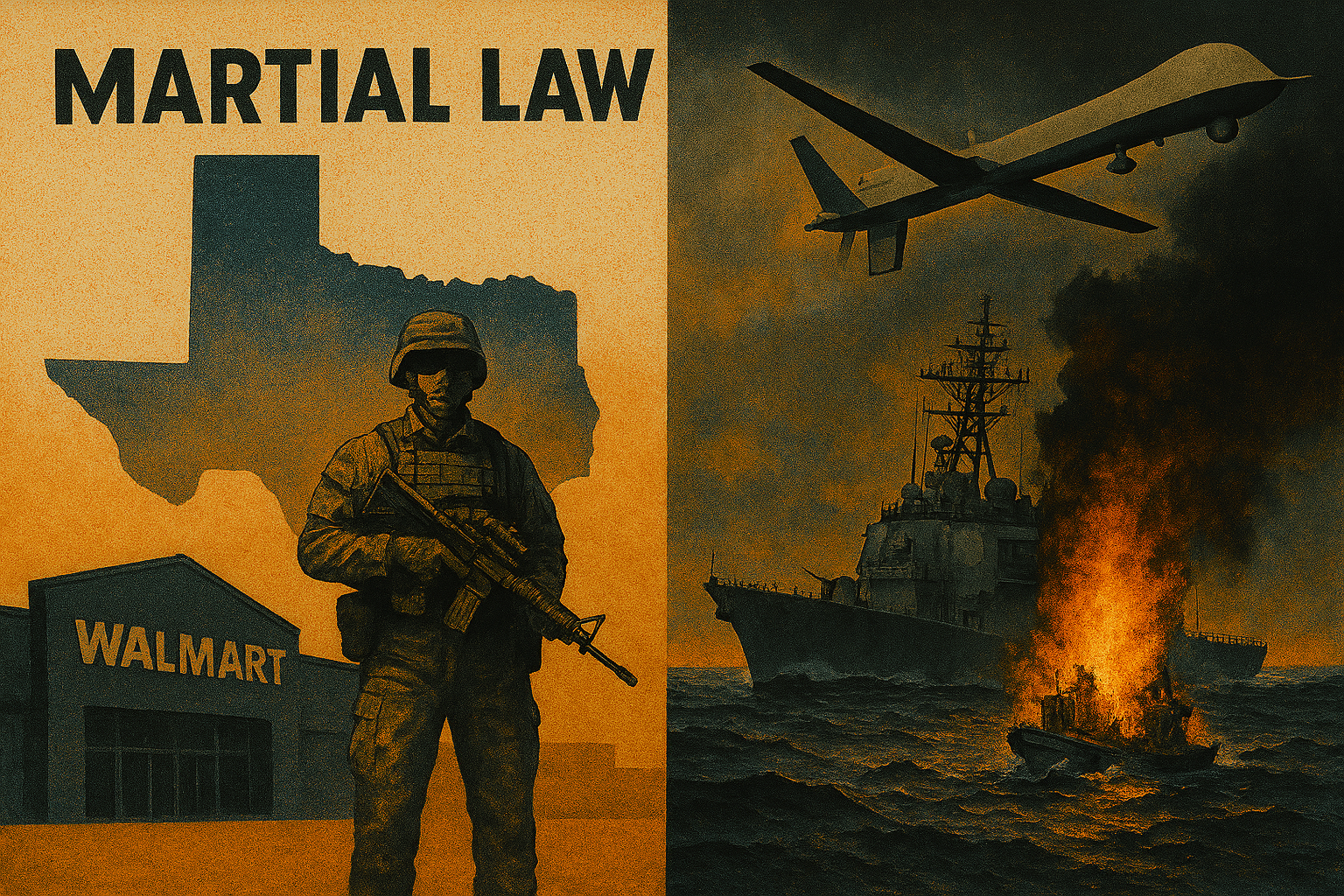
Back in 2015, a routine Special Operations exercise known as Jade Helm 15 metastasized into a Texas‑sized panic about martial law and Walmart tunnels. Governor Greg Abbott even ordered the Texas State Guard to “monitor” the drill; nothing happened, of course, beyond the headlines (PolitiFact). The conspiracy was the story. Meanwhile, the real risks of executive power—lethal ones—were growing offstage.
It was the coup that never came. Jade Helm 15 was a training exercise, but conspiracy theorists saw FEMA camps under Walmart and martial law on the horizon. The fear was of masked troops roaming American streets, rounding up citizens without due process.
From Phantom Coups to Real Snatch Squads
Fast forward a few years, and that dystopia wasn’t a fever dream—it was livestreamed. In Portland and other cities, unmarked vans and masked federal agents grabbed protesters off sidewalks during the 2020 unrest. No insignia, no clear chain of command, no warrants—just the raw assertion of executive power. The irony? Many who once warned of tyranny under Obama cheered these real-life snatch squads under Trump. The imagined coup never came; the unaccountable force did.
Masked Agents, Military Streets
By mid‑2025, the dystopian imagery Jade Helm conspiracists once imagined had become reality—only this time, it wasn’t a drill. In Los Angeles, Washington, and other cities, federalized National Guard troops and even Marines patrolled neighborhoods, a move a federal judge later ruled violated the Posse Comitatus Act, which bars the military from enforcing domestic law. At the same time, masked ICE agents in plain clothes, driving unmarked vans, were grabbing people off sidewalks, often without identifying themselves—tactics condemned by 21 state attorneys general as “secret police” practices that erode democratic accountability. Critics warned these operations blurred the line between law enforcement and military occupation, creating a climate where Americans couldn’t tell the difference between a lawful arrest and a kidnapping (Axios).
II. The day America put a citizen on the kill list
On September 30, 2011, a U.S. drone killed Anwar al‑Awlaki, an American accused of being a senior operational leader of al‑Qaeda in the Arabian Peninsula. Two weeks later, a separate strike killed his 16‑year‑old son, Abdulrahman. The Obama administration said Awlaki posed a continuing, imminent threat and that capture was infeasible—arguments laid out in a DOJ white paper, a later‑released OLC memo, and the President’s NDU speech (DOJ white paper — link | OLC memo — Lawfare | NDU speech — White House Archives).
Attorney General Eric Holder later acknowledged that four U.S. citizens were killed in counterterrorism operations during that period, but only Awlaki was specifically targeted (Holder letter — USA Today).
III. From interdiction to incineration: the 2025 boat war
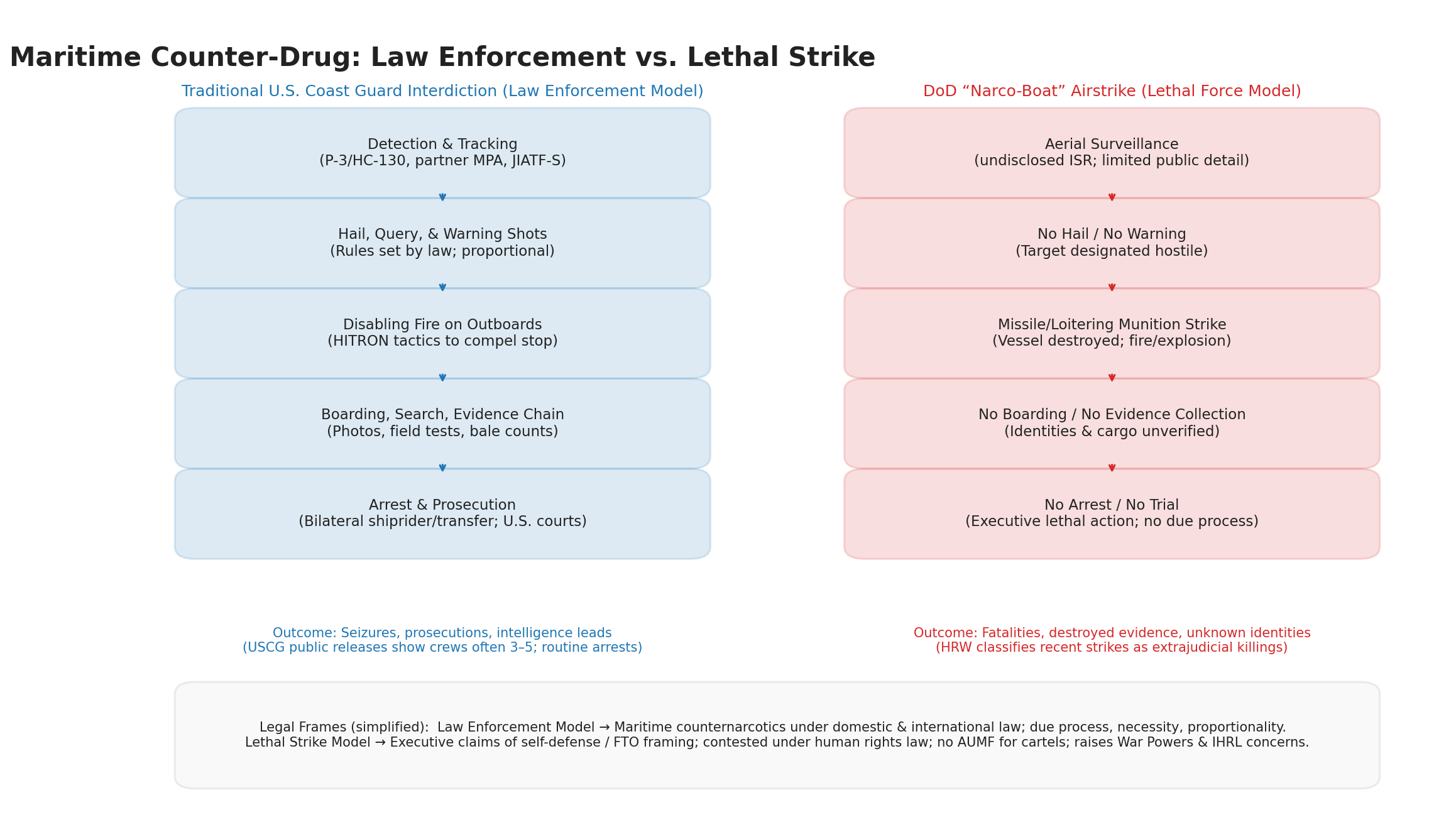
On September 2, 2025, the President announced a lethal strike on a small boat in international waters, alleging it carried Venezuelan gang members designated as a foreign terrorist organization. Eleven people died. Days later, a second and third strike followed. Unlike the Coast Guard’s established playbook—hail, warn, disable, board, arrest—these were summary destructions of vessels with no on‑scene evidence collection or arrests (U.S. Naval Institute Proceedings).
When Congress asked for the legal basis, the Pentagon and nominees largely demurred, canceled briefings, or gestured at Article II “self‑defense,” even as legal experts and lawmakers stressed there is no AUMF for cartels and that an FTO designation does not itself authorize war‑like force (Defense One). Human Rights Watch called the boat attacks extrajudicial killings under international human rights law (Human Rights Watch).
IV. The fisherman problem (it’s not hypothetical)
Extrajudicial killings with murky legal authority are hardly new to the Trump administration. In 2019, during high‑stakes diplomacy with Pyongyang, U.S. special operators slipped toward a North Korean shore to plant a covert listening device. According to later reporting, they encountered a small fishing boat, opened fire, and killed civilians diving for shellfish—then allegedly disposed of the bodies to avoid discovery. The mission was aborted; Congress, according to the coverage, was not notified at the time (U.S. News | Explainer —Task & Purpose).
If elite SEALs can misread a small boat at night, the odds of misidentification in a low‑fidelity drone clip are not academic. Destroying vessels in place eliminates the very mechanisms—boarding, evidence recovery, interviews—that separate smugglers from shellfish divers.
Key differences, in one paragraph: The Awlaki strike—however controversial—stood on a declared legal scaffold: the 2001 AUMF, Article II, and a self‑defense rationale, with explicit criteria like “imminent threat,” “capture infeasible,” and law‑of‑war compliance. Those standards were spelled out in a DOJ white paper, an OLC memo, and a presidential speech—documents Congress and the courts could at least interrogate. The boat strikes? They rest on a bare claim of Article II power and a terror label that creates no new authority. No memo. No evidence chain. No arrests. Just fireballs in international waters—a wholesale break from decades of maritime law‑enforcement norms (DOJ White Paper | Defense One).
What haunts me is this: What did they tell the nineteen‑year‑old who pulled the trigger? How do you convince someone that vaporizing a boat full of people isn’t murder? Since Nuremberg, every soldier is taught that “just following orders” won’t shield them from prosecution for obvious crimes. And what is this if not that? Drug smuggling isn’t a capital offense. There is no war here, no declared battlefield, no enemy combatants—yet the penalty was death by missile.
Looking through Liberty’s Lens, I can’t forget the reporting that Trump once asked if protesters could be shot in the legs. Now, soldiers under his command obliterate boats without knowing who’s aboard, without proof of guilt, and without any process that even pretends to be justice. Even if those men had been guilty, the law does not punish smuggling with execution. This isn’t law enforcement. It isn’t even counterterrorism as we once defined it. It is an act of war—ordered by a president who still wants a Nobel Peace Prize (NPR).
And Trump wants Chicago to ‘find out why they call it the department of war?’ No wonder Governor Pritzker wants no ‘help’ from Donald ‘we’re still deciding the legal authority for those murders’ Trump. I think the people of Illinois should be grateful for their Governor’s wisdom.
V. Why swapping law for spectacle makes us weaker
Strategic theater. Most U.S. overdose deaths don’t trace to Hollywood-style go‑fast boats slicing through blue water. They come through ports, parcels, and land routes. Blowing up skiffs in the Caribbean doesn’t disrupt supply chains—it destroys evidence, erases intelligence leads, and trades real interdiction for Instagrammable fireballs.
Constitutional freefall. We once panicked over phantom FEMA tunnels; now we applaud real, unreviewable state killings in peacetime, far from any battlefield. That’s how norms collapse—not with tanks in the streets, but with missiles at sea and cheers from the bleachers (PolitiFact).
From Phantom Tyranny to Applauded Power
In 2015, the right warned of FEMA camps and martial law, clutching their guns against a phantom coup. In 2011, they raged over a drone strike on an American who joined al‑Qaeda, calling it the death of due process. Fast forward: masked troops patrol U.S. streets in defiance of Posse Comitatus, and boats full of unidentified men vanish in fireballs on the high seas—cheered on by the same voices that once cried tyranny. What changed? The principle didn’t. The power did. And if this isn’t the line, what will it take for them to see the danger?
VI. A better way forward
- Restore the Coast Guard lead for maritime counternarcotics; reserve lethal force for true imminence vetted by judge advocates and documented to Congress (U.S. Naval Institute Proceedings).
- Publish the memo. If the administration believes the law allows boat killings in peacetime, release the legal analysis and facts—classification isn’t a blank check (Defense One).
- Commit to post‑strike transparency. Names, locations, munition types, evidence, and casualty assessments—every time (Human Rights Watch).
For readers who want the receipts
- Legal ambiguity and withheld details on the Sept. 2, 2025 strike; White House gestured at self‑defense — (ABC News).
- Senators and experts question authority; FTO designation does not create new targeting powers — (Defense One).
- Human Rights Watch classifies recent maritime strikes as unlawful extrajudicial killings — (Human Rights Watch).
- Coast Guard interdiction norms versus lethal strike model — (U.S. Naval Institute Proceedings).
- DOJ white paper on targeting a U.S. citizen who is a senior al‑Qaeda leader — (Department of Justice).
- Redacted OLC memo on the Awlaki strike released via FOIA — (Lawfare).
- Holder’s letter acknowledging four U.S. citizens killed (only Awlaki targeted) — (USA Today).
- North Korea mission reporting: fishermen killed during failed listening‑device operation; Congress not notified at the time, per coverage — (Reuters via U.S. News) and (Task & Purpose).
- Jade Helm panic and the governor’s monitoring order — (PolitiFact).
— Liberty’s Lens
This article is provided for public interest reporting and analysis. All external links open in a new tab and point to their original publishers.
See also—https://medium.com/@LibertysLens/ghosts-at-sea-narco-terror-small-boats-and-the-death-of-due-process-89ba5ce2164b