Nothing About Ukraine Without Ukraine
The Alaska Summit and the Selling of ‘Energetic Diplomacy’
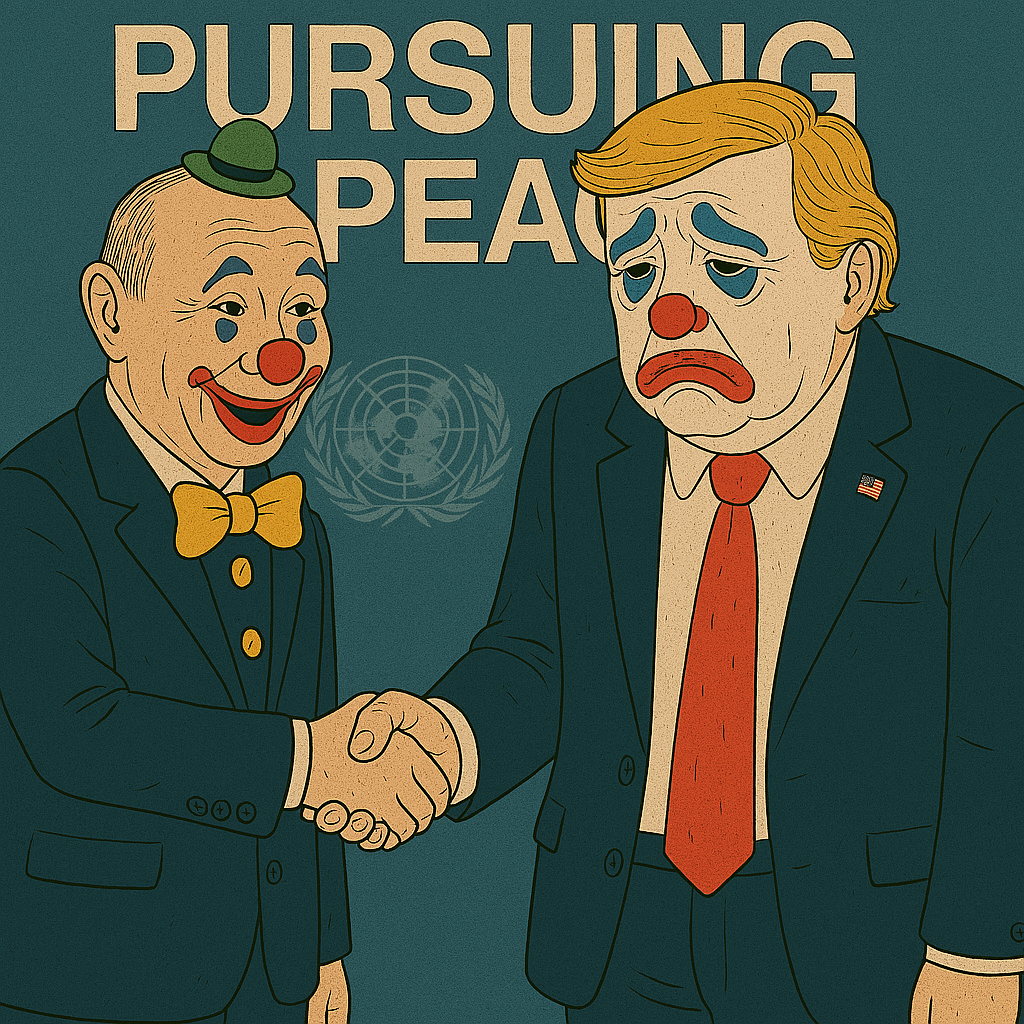
The images out of Anchorage were made for television: a red carpet rolled across a windswept tarmac; an armored limo’s doors opening to admit two men whose political fortunes have been intertwined for nearly a decade; a backdrop that literally read “Pursuing Peace,” followed by a press availability where Vladimir Putin spoke first on American soil while Donald Trump nodded along. The pageantry was loud. The substance was quiet: no ceasefire, no map, no mechanism—just a promise that “there’s no deal until there’s a deal,” and a post-summit spin blitz to make stalemate look like progress (CBS News; Newsweek).
Into that vacuum stepped Vice President J.D. Vance, touting what he calls “energetic diplomacy,” insisting that “significant concessions” have already been made—though he struggles to name them—and casting tariffs and pressure campaigns as proof that Washington is driving toward a just peace. Meanwhile, European leaders are waving every available red flag: you can’t negotiate the future of Ukraine without Ukraine, and you certainly can’t do it by opening a catalog of “territory swaps,” as if borders erased by force could be bartered back like condo square footage.
The optics of progress vs. the absence of terms
Post-summit, Trump and Putin both used the same vibe words—“constructive,” “useful,” “progress”—but neither leader articulated even a skeletal framework: no freeze line, no verification regime, no sanctions pathway tied to compliance, no dispute-resolution mechanism, and no security architecture that doesn’t depend on Ukraine surrendering the sovereign right to choose its alliances (CBS News). Trump then told Fox that it’s now “up to Zelenskyy to get it done,” a formulation that implies the hard work is over because the photo-op is over, and that Kyiv’s job is to ratify momentum that exists mostly in the press releases.
Vance’s follow-on claim—that Moscow has made “significant concessions” and recognized Ukraine’s territorial integrity—floats in midair. On the record, Russia continues to insist on recognition of the annexations of Crimea and four additional regions, plus limits on Ukraine’s military and a veto over its Western ties. That’s not territorial integrity; that’s a dictated capitulation dressed in euphemism. And Russia’s own foreign minister promptly undercut the supposed “within two weeks” leader-to-leader meeting between Putin and Zelensky, saying the agenda “is not ready at all” (The Independent).
‘Energetic diplomacy’ or kinetic appeasement?
The phrase markets well. It suggests hustle and leverage rather than drift and driftwood. Vance points to “aggressive economic leverage,” including secondary tariffs, as proof that Washington is squeezing Russia’s wartime financing via its oil lifelines. But here’s the reality: the tariff threat is on ice, not active. Trump had floated sweeping secondary tariffs—up to 100%—on countries still buying Russian oil, even slapping India with a 50% rate in July. Yet after the Alaska summit, he publicly backed off, saying he didn’t “have to think about that” because of “progress” with Putin. He left the door open to revisit tariffs in “two or three weeks,” but for now, the pressure tool Vance touts is more rhetorical than real (CBS News; NBC News).
The Tariff Timeline—From Threat to Pause
- July: Trump floated sweeping secondary tariffs—up to 100%—on countries still buying Russian oil, even imposing a 50% rate on India as a warning shot.
- Pre-Summit Rhetoric: Vance cited these moves as proof of “aggressive economic leverage” under the banner of energetic diplomacy.
- Post-Alaska Summit: Trump publicly backed off, saying he didn’t “have to think about that” because of “progress” with Putin. He left the door open to revisit tariffs in “two or three weeks,” but for now, the escalation is on hold.
- Bottom Line: The tariff threat remains a bargaining chip, but it’s not active leverage—at least not today.
The surrealism of soft power theater
Then there’s the letter. The First Lady sent Putin a personal appeal about “protecting children… with the stroke of a pen,” which the President publicized as he blasted media coverage of the summit’s lack of deliverables (The Independent). It’s not wrong to speak of children in a war defined by mass displacement and school-targeting strikes. It is wrong to confuse sentiment with structure, or to let the gauze of moral suasion cover the hard math of deterrence and verification. Moscow’s calculus won’t be shifted by prose. It will be shifted by battlefield reality, financial isolation that actually bites, and a negotiating table where the party whose land is occupied sits at the head, not in the hallway.
What a real peace path requires
If the goal is a durable peace—not a photo-op ceasefire that collapses as soon as Russia reloads—three conditions are non-negotiable:
- Kyiv must be a principal, not a prop. The democratic government defending its sovereignty cannot be strong-armed into “swaps” that reward invasion. That’s not only immoral; it’s strategically illiterate. It would fracture European unity, embolden revanchists elsewhere, and lock in a template where artillery creates bargaining chips.
- Security guarantees must mean something. If NATO membership remains politically out of reach in the near term, any “Article 5-like” assurance has to be backed by pre-positioned capabilities, snapback sanctions that trigger automatically upon violations, and a multilateral enforcement coalition—not vague pledges that evaporate when tested.
- Leverage has to accumulate, not pause for optics. If tariffs and secondary sanctions are the tools, they must be structured to constrict the arteries of Russia’s war economy—oil revenues, components for missiles and drones, financial plumbing—and they must be coordinated with Europe and key swing states. Announcing “severe consequences” and then shelving them because a meeting felt “productive” is the opposite of leverage; it’s a signal that optics outrank outcomes.
The lesson Europe remembers—and America should
The core Western principle since February 2022 has been brutally simple: borders cannot be moved by force. Every inch legitimized by negotiation under duress becomes a down payment on the next war. That’s why Europe responded so quickly and so publicly to the Alaska gambit, reminding Washington that unity depends on consent and law, not vibes and venue. The creed “Nothing about Ukraine without Ukraine” isn’t a hashtag; it’s a guardrail against sleepwalking into a world where aggression pays interest.
Someday, there will be a deal. Wars end. The question is on whose terms. If “energetic diplomacy” becomes a brand name for concessions without accountability, then the United States won’t be ending a war; it will be underwriting the next one. And history will rhyme—loudly.