Quiet Quitting the Union: How Blue States Are Withdrawing Consent from Authoritarian Rule
When enforcement requires cooperation, refusal is power.
America’s federal architecture gives states a lawful, durable way to starve authoritarianism of the oxygen it needs: their people, their infrastructure, and their consent.
Clocking Out of Compliance: Why States Are Quietly Walking Away
Behind closed doors, blue‑state leaders are scripting a different kind of showdown. Not a Fort Sumter replay, but a slow, methodical quiet quit from cooperation: attorneys general sharing litigation templates at 8 AM calls; governors building coalitions that can file suit within hours; legislatures passing targeted statutes that make federal overreach hard to implement and easy to lose in court. During Trump’s first term, state attorneys general mounted more than a hundred multistate suits against the administration and won the vast majority (The Hill | AOL recap).
If the federal project drifts toward government by threat—retaliatory funding cuts, mass roundups, rule‑by‑EO—the constitutional answer isn’t symbolic standoffs. It’s time for states to act their wage.
How Blue-State Leaders Are Preparing America for a New Gig
This isn’t theory—it’s coordinated.
- California: Gov. Gavin Newsom called a special legislative session to “Trump‑proof” state law, while AG Rob Bonta confirmed they’ve “gone down to the detail of: What court do we file in?”—meaning his team has draft lawsuits ready to challenge everything from a national abortion ban to Project 2025’s regulatory rollbacks, and they’ve mapped out which courts to file in for the best chance at injunctions.
- New York: Gov. Kathy Hochul and AG Letitia James launched the Empire State Freedom Initiative to counter federal overreach on reproductive rights, immigration, and environmental justice.
- Illinois: Gov. JB Pritzker is coordinating with other Midwestern governors, reviewing Project 2025 line by line, and drafting laws to protect medical data and transponder records from out‑of‑state subpoenas (NBC News).
Encrypted calls, “brief banks,” and coalition playbooks are the new normal. States are logging off from unpaid federal mandates and quietly building parallel systems to protect their residents.
Act Your Wage: The Legal Framework for Saying No
Two Supreme Court pillars define the field: anti‑commandeering and state lawmaking autonomy.
- In Printz v. United States (1997), the Court held the federal government cannot require state officials to administer or enforce federal programs (Cornell LII | Oyez).
- In Murphy v. NCAA (2018), the Court made clear Congress can’t forbid states from changing their laws; if Washington wants something done, it must regulate private actors itself, not commandeer state governments (Supreme Court slip opinion | Cornell Constitution Annotated).
Yale’s Heather Gerken calls this “uncooperative federalism”—using the state’s insider position to lawfully dissent, delay, and redirect policy (Yale Law Journal).
How to Quiet Quit Federal Overreach (Legally)
Immigration: States codify refusal to assist civil immigration enforcement beyond what federal law compels. Washington’s AG sued a sheriff for allegedly violating those limits (AG release | KUOW).
Elections: Nine states now have state VRAs; 24 states + DC run automatic voter registration; Colorado mandates risk‑limiting audits and paper ballots (NCSL | Ballotpedia | CO SoS).
Climate: RGGI’s 11‑state compact cut power‑sector CO₂ by ~50% since 2005; U.S. Climate Alliance governors represent ~60% of the economy (RGGI | USCA).
Health care: Over 20 states have provider shield laws for abortion; ~18 and DC extend protections to gender‑affirming care (Guttmacher | KFF).
Deep Dive: Inside a Shield Law—What States Protect
- Blocks out-of-state subpoenas, warrants, and extradition for providers and patients.
- Prohibits state agencies from aiding hostile investigations.
- Protects medical data and location info (apps, EHRs).
- Shields providers from civil liability and professional discipline.
- Some states extend protections to telehealth and allow clawback lawsuits against out-of-state judgments.
Full details: Guttmacher | KFF Tracker.
Withholding Overtime: Using Financial Leverage Without Breaking the Rules
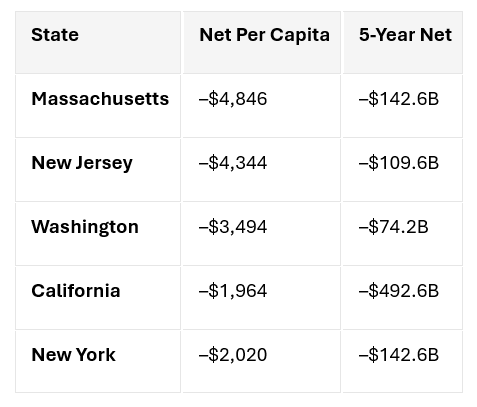
Blue states subsidize red states by hundreds of billions annually. Here’s the math:
Listen, Let’s Not Rage Quit
I’ve heard some bad ideas out there—schemes that sound bold but would backfire fast. Quiet quitting works because it’s lawful, durable, and defensible. Rage quitting? That’s how you hand authoritarianism a win in court. Here’s what to avoid—and what to do instead.
What Not to Do
Sabotage ACH or SWIFT flows
Why it’s bad: These are federally controlled payment rails (FedACH, The Clearing House) and international systems (SWIFT). Interfering would be illegal, preempted, and enjoined immediately.
What to do instead:
- Enact data‑minimization laws for state datasets
Why it works: Limits federal fishing expeditions by requiring narrow, lawful requests. Protects residents’ privacy and forces the feds to litigate overreach. - Condition procurement on civil‑rights and privacy baselines
Why it works: States spend billions on tech and infrastructure. Leveraging contracts ensures vendors meet state standards without violating federal supremacy. - Build public‑finance capacity (e.g., state banks like Bank of North Dakota)
Why it works: Creates buffers against federal funding threats aimed at forcing compliance by withholding grants or reimbursements. Instead, this keeps capital circulating locally for critical programs in the near-term allowing critical programs to weather the storm.
Don’t Burn Bridges: Bad Ideas vs. Smart Resistance
- Throttle federal tax transfers
Why it’s tempting: Slows federal cash flow, creates leverage.
Why it fails: Illegal, preempted, and invites injunctions.
✅ Instead: Privacy and security standards that apply to all external data requests, forcing lawful process and transparency. - Close state airspace
Why it’s tempting: Blocks deportation flights.
Why it fails: FAA has exclusive control of U.S. airspace.
✅ Instead: Regulate state-controlled assets like airports and contracts with neutral, safety-based standards. - Ban licenses for red-state doctors
Why it’s tempting: Punishes states criminalizing care.
Why it fails: Violates Full Faith and Credit and Dormant Commerce Clause.
✅ Instead: Expand shield laws and fast-track reciprocity for targeted clinicians. - Fake “compatibility issues”
Why it’s tempting: Bureaucratic slow-walk.
Why it fails: Obstruction risk and bad optics.
✅ Instead: Uniform cybersecurity standards applied to all external requests, making compliance lawful and defensible.
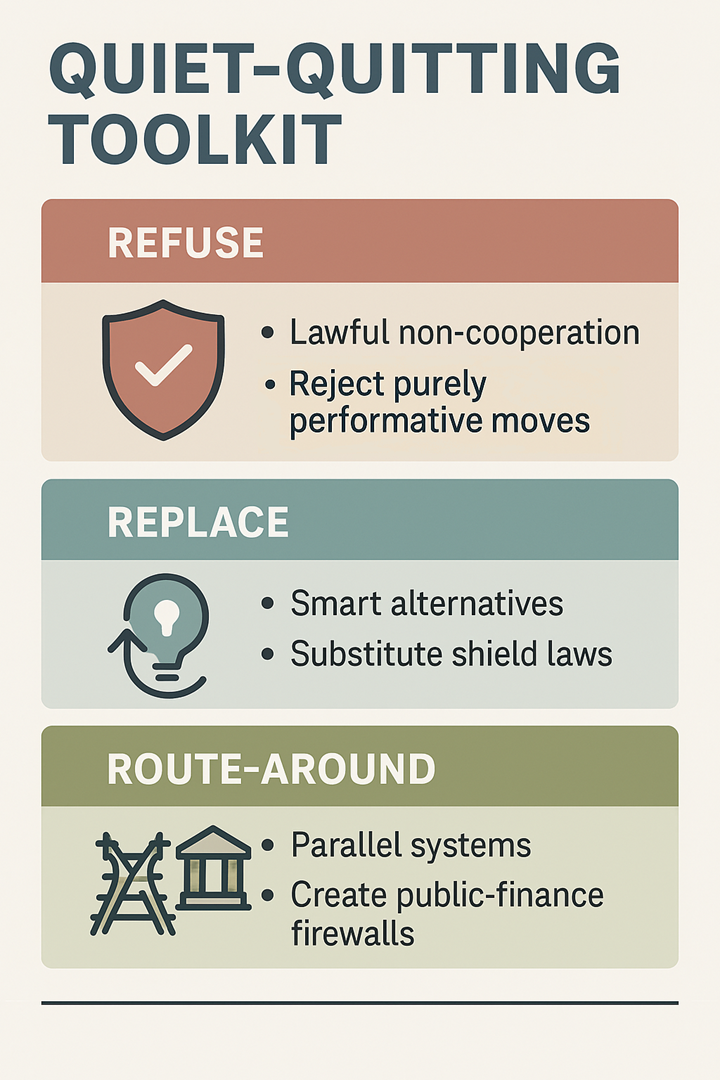
Your Quiet‑Quitting Toolkit: Refuse, Replace, Route‑Around
Deep Dive: What’s in a State Voting Rights Act?
- Preclearance: Local jurisdictions need approval before changing election rules.
- Vote Dilution Protections: Stops maps that weaken minority voting power.
- Language Access: Requires multilingual ballots and assistance.
- Private Right of Action: Lets voters sue for violations.
- Coalition Districts: Allows combined minority groups to elect candidates of choice.
Learn more: NCSL | MAP Research.
Deep Dive: How RGGI Works—and Why It Matters
- Cap-and-Trade: Power plants buy allowances for every ton of CO₂.
- Declining Cap: Regional emissions cap drops annually.
- Revenue: Over $7B raised for clean energy and bill relief.
- Impact: CO₂ down ~50% since 2005—twice the national rate.
- Health Benefits: Hundreds of lives saved, billions in avoided health costs.
Details: RGGI Fact Sheet | Abt Global Analysis.
The Exit Interview: Why Quiet Quitting Works
Authoritarians thrive on centralized levers—money, mandates, and the illusion of inevitability. Federalism breaks those levers in half. You can’t deport millions without blue‑state cooperation. You can’t criminalize lawful care if the forums, data, and professionals you need refuse to help. You can’t hollow out democracy when the places most of the economy lives decide not to carry your water.
It’s time for blue-states to fight back—quietly, lawfully, and relentlessly.
A nod to Governors Safeguarding Democracy
What it is: A coalition launched by Gov. JB Pritzker and Gov. Jared Polis to coordinate state-level defenses against authoritarian policies.
What they do: Share legal templates, align legislative calendars, and pool resources for rapid-response litigation.
Why it matters: It’s the first formalized interstate network focused on democracy protection, not just issue-specific advocacy.
Learn more: Governors Safeguarding Democracy.
For readers who want the receipts
Multistate lawsuits: Over 100 filed by Democratic AGs during Trump’s first term, most successful. (The Hill, AOL)
Coordinated resistance: Governors and AGs prepped lawsuits and mapped court strategies. (NBC News)
Legal foundation: States can’t be forced to enforce federal law. (Printz v. United States, Murphy v. NCAA)
Uncooperative federalism: Lawful dissent from within the system. (Yale Law Journal)
Shield laws and AG actions: States protecting residents from hostile subpoenas and enforcement. (KUOW)
State-level democracy protections: VRA laws, automatic registration, audit standards. (NCSL, Ballotpedia)
Climate coalitions: RGGI and USCA driving emissions cuts and legal challenges. (RGGI)
Health care protections: Abortion and gender care shield laws expanding. (Guttmacher, KFF)
Fiscal leverage: Blue states subsidize red states by billions. (Rockefeller Institute, Axios)