The Enemy Within: How Trump Is Rewriting the Rules of Power
NSPM‑7 criminalizes ideology, Navy speeches militarize politics, and strikes normalize extrajudicial force.
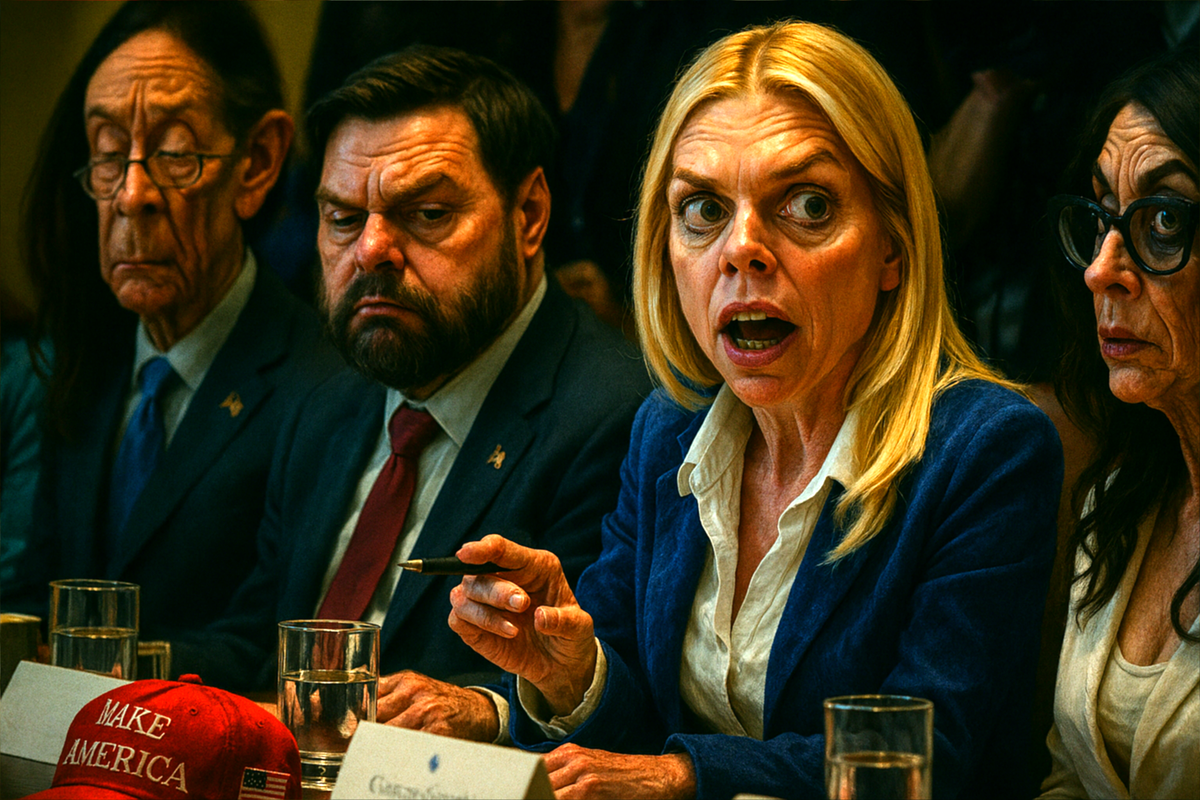
“The best form of government would be an authoritarian strongman who had your best interests in heart — which turns out to be Trump. Is he an authoritarian? Yes. Is he a strong man? I’d say yes.” — Scott Adams
MAGA stalwart and ‘Dilbert’ author Scott Adams—a rightwing influencer with more than a million followers—didn’t whisper that; he said it plainly in a recent video. It lands like a punchline until you line it up against what the administration has done—and said—in the span of days: a domestic terrorism memo that treats ideology as a red flag, a uniformed‑forces audience told to “take care of” Democrats, and a claim to wartime powers without new authorization from Congress. Seen together, they read as the operational rollout of a theory that has migrated from the seminar room to the Situation Room.
That theory is post‑liberalism: the belief that liberal democracy’s focus on individual rights and market neutrality hollowed out the nation’s civic and moral core, and that a strong state should enforce a substantive vision of the common good. It is no longer a boutique argument; it is shaping governing instincts at the highest levels, including those of Vice President JD Vance, who has aligned himself with Catholic post‑liberal thinkers calling for “regime change” to a post‑liberal order (PBS).
The Post‑Liberal Frame
Post-liberalism isn’t just a buzzword—it’s a blueprint for a different kind of state. At its core, it argues that liberal democracy, with its emphasis on individual rights and market neutrality, has hollowed out the moral and social fabric of society. Post-liberal thinkers claim that freedom without a shared moral order leads to chaos, so the state should actively enforce a vision of the “common good” (PBS).
What would that mean for people?
- Less individual autonomy: Expect laws that regulate personal choices—family structure, education, even speech—based on a prescribed moral code.
- State over marketplace: Economic policy would prioritize cultural goals over free-market principles, favoring industries or practices deemed “virtuous.”
- Religion in governance: Many post-liberal theorists advocate embedding Christian norms into law, which could marginalize non-Christian citizens.
- Curtailment of dissent: Political opposition isn’t just wrong—it’s framed as destabilizing or even “anti-American,” paving the way for surveillance and criminalization of ideological differences.
- Judicial overhaul: Courts would shift from protecting individual rights to enforcing communal obligations, eroding checks on executive power.
Is Post-Liberalism Anti-Democratic?
- Post-liberalism claims to improve democracy by enforcing a shared moral order.
- In practice, it weakens liberal norms like pluralism, minority rights, and judicial independence.
- It favors strong executive power and centralized control over dissent.
- Religion and cultural enforcement often replace neutral governance.
- It doesn’t abolish elections—but it hollows out the safeguards that make democracy meaningful.
Vice President JD Vance has publicly situated himself in this milieu and has argued there is “no meaningful distinction between the public and the private sector in the American regime,” a formulation that justifies deeper state direction of economic and civic life (Mediaite).
NSPM‑7: The Legal Architecture
On September 25, the White House published National Security Presidential Memorandum‑7, a domestic terrorism directive that starts with assassinations and attacks—and then broadens to ideology. It lists “anti‑Americanism, anti‑capitalism, and anti‑Christianity” as common threads among domestic terrorists and instructs law enforcement to “disband and uproot networks, entities, and organizations,” while ordering the Attorney General to prioritize “organized doxing… swatting… threats of violence, and civil disorder” as terrorism predicates (Federal Register).
Civil‑liberties experts warn this conflates violent conduct with constitutionally protected speech and association—casting a wide net over universities, nonprofits, and protest movements under the guise of preempting “organized political violence.” The concern isn’t that crimes would go unpunished, but that lawful dissent and advocacy could be surveilled or sanctioned as terror‑adjacent because of their ideas rather than their actions (The Daily Pennsylvanian).
There are common recurrent motivations and indicia uniting this pattern of violent and terroristic activities under the umbrella of self-described “anti-fascism.” These movements portray foundational American principles (e.g., support for law enforcement and border control) as “fascist” to justify and encourage acts of violent revolution. This “anti-fascist” lie has become the organizing rallying cry used by domestic terrorists to wage a violent assault against democratic institutions, constitutional rights, and fundamental American liberties. Common threads animating this violent conduct include anti-Americanism, anti-capitalism, and anti-Christianity; support for the overthrow of the United States Government; extremism on migration, race, and gender; and hostility towards those who hold traditional American views on family, religion, and morality.
As described in the Order of September 22, 2025 (Designating Antifa as a Domestic Terrorist Organization), the groups and entities that perpetuate this extremism have created a movement that embraces and elevates violence to achieve policy outcomes, including justifying additional assassinations.
The United States requires a national strategy to investigate and disrupt networks, entities, and organizations that foment political violence so that law enforcement can intervene in criminal conspiracies before they result in violent political acts. Through this comprehensive strategy, law enforcement will disband and uproot networks, entities, and organizations that promote organized violence, violent intimidation, conspiracies against rights, and other efforts to disrupt the functioning of a democratic society.
The Attorney General shall issue specific guidance that ensures domestic terrorism priorities include politically motivated terrorist acts such as organized doxing campaigns, swatting, rioting, looting, trespass, assault, destruction of property, threats of violence, and civil disorder.
It’s a long read, but worth unpacking. The memo spends considerable time defining “ANTIFA” so broadly that anything contrary to MAGA’s values, policy priorities, or political ambitions can be swept under that label. It literally cites “hostility towards those who hold traditional American views on family, religion, and morality”—which is shorthand for hostility toward MAGA itself. In effect, dissent becomes “ANTIFA.”
From there, the logic is simple and chilling: ANTIFA glorifies violence, therefore ANTIFA is terroristic. Liberty’s Lens opposes political violence, full stop—but look closely at what counts as “terrorism” here. Terms like “conspiracies against rights” and “efforts to disrupt the functioning of a democratic society” are so vague they could encompass protest or civil disobedience. Even “organized doxing” (a term the administration has applied to apps like ICEblock, which merely track public enforcement actions), “trespass,” and “civil disorder” are listed as terrorism predicates. It’s not hard to see why civil libertarians call this the criminalization of dissent.
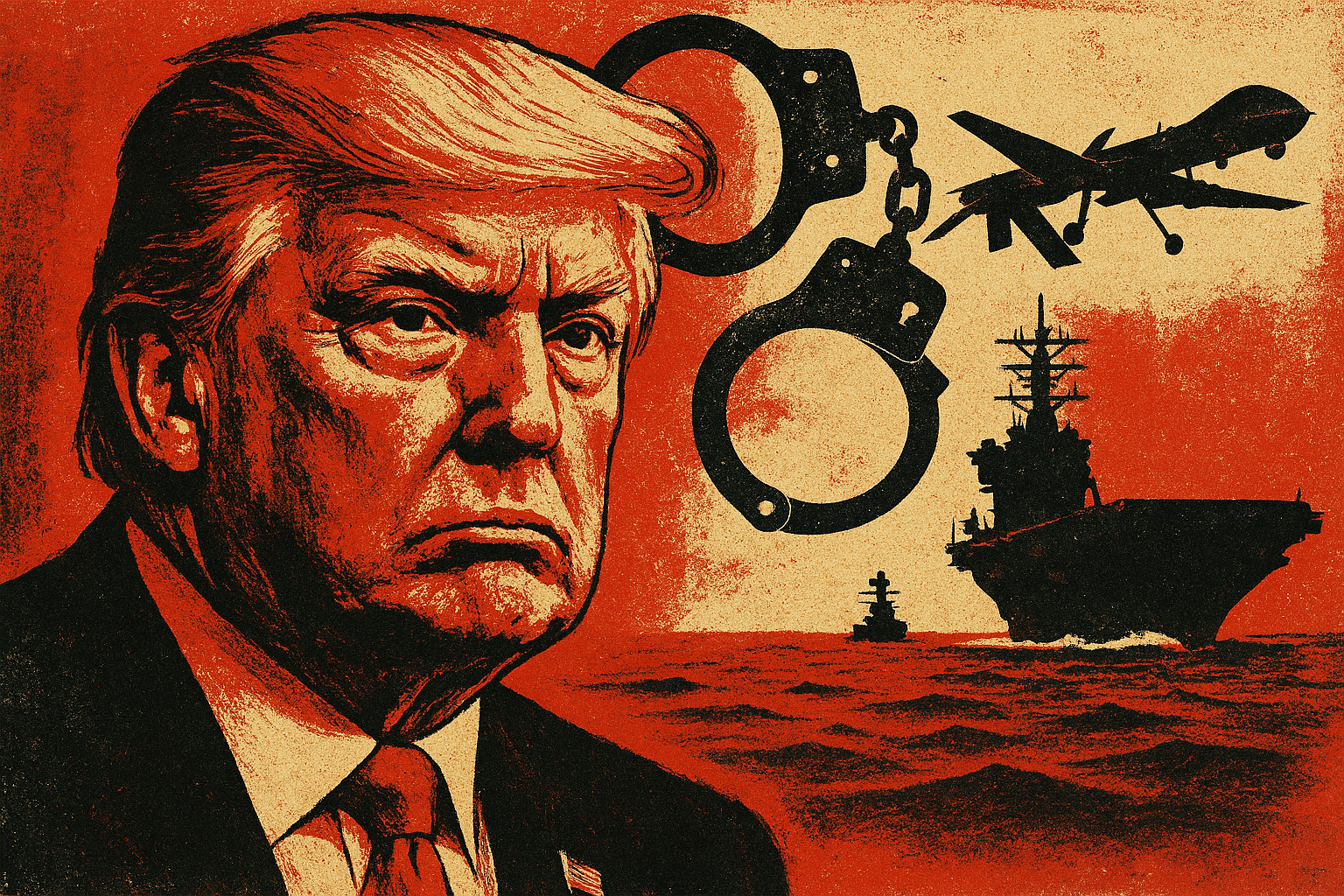
Trump’s Norfolk Speech: The Trigger
“We have to take care of this little gnat that’s on our shoulder called the Democrats.” — Donald Trump
On October 5 at Naval Station Norfolk, the President told thousands of sailors, “We have to take care of this little gnat that’s on our shoulder called the Democrats,” before accusing the party of wanting to “give all of our money to illegal aliens” and boasting about military spending (Yahoo News). In a military setting that is supposed to be rigorously nonpartisan, the Commander‑in‑Chief publicly cast a domestic political party as a pest to be removed. That is not routine political rhetoric; it is a normative break in civil‑military relations, especially on the heels of a memo that redefines ideological dissent as terror‑adjacent.
Set alongside NSPM‑7, the Norfolk line lands as a direction of travel: identify the ideological enemy class, then signal to the uniformed services that the “gnat” on the nation’s shoulder is partisan and domestic. The timing matters; it stitches the legal, rhetorical, and operational elements into a single garment.
Authoritarian Echoes
And the chorus is growing louder. Senior allies and high‑profile supporters are saying the quiet part out loud—recasting lawful judicial decisions and independent courts as enemies to be subdued.
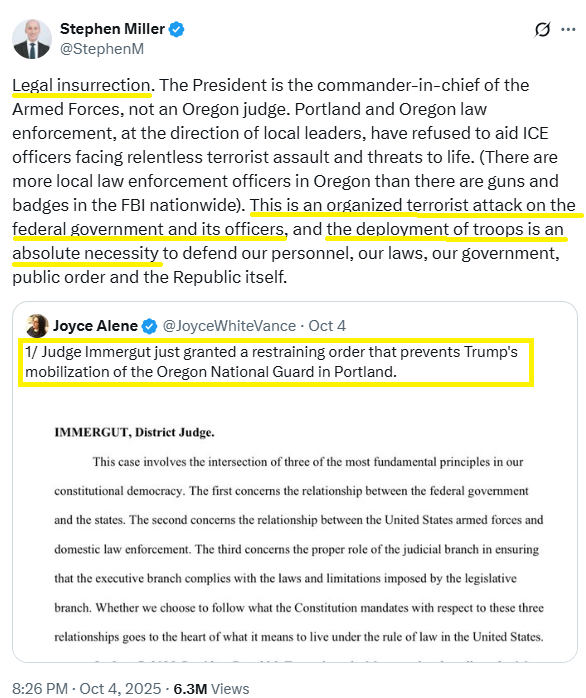
“Legal insurrection. The President is the commander‑in‑chief of the Armed Forces, not an Oregon judge… This is an organized terrorist attack on the federal government and its officers, and the deployment of troops is an absolute necessity to defend our personnel, our laws, our government, public order and the Republic itself.” — Stephen Miller, on X
That is not merely overheated language; it reframes judicial review and local law‑enforcement discretion as insurrection and rationalizes military deployment against domestic opponents. Elon Musk amplified the same instinct when he boosted a call to “Bukele our court system”—explicitly invoking El Salvador’s president, who neutered judicial independence—labeling the suggestion “essential,” and replying “treason” to criticism of a federal judge (The Nation). These are not asides. They are endorsements of a model where courts and cops bend to executive will, and resistance is rebranded as rebellion.
From Cartels to Citizens
In late September and early October, U.S. forces conducted multiple “kinetic” strikes on small boats in the Caribbean that officials said were ferrying narcotics for terrorist‑designated cartels. The administration then notified Congress that the United States is in a “non‑international armed conflict” with those cartels and that the dead were “unlawful combatants”—a claim of wartime authority without new authorization for the use of military force. Video of one strike near Venezuela was posted by the Secretary of War, who vowed, “these strikes will continue” (CBS News).
Legal and human‑rights experts have questioned both the targeting criteria and the precedent: if the President can unilaterally decide who the unlawful combatants are on the high seas, kill them without trial, and then expand the definition of domestic “terror” to include broad ideological categories at home, what firewall prevents those war powers from migrating inward?
The Pattern: It’s All Connected
Within roughly ten days, the President:
- Issued a national‑security memo that treats dissenting ideologies—“anti‑capitalist,” “anti‑American,” “anti‑Christian”—as indicia for domestic terrorism (Federal Register).
- Told the military “we have to take care of” Democrats (Yahoo News).
- Asserted to Congress that he can kill “unlawful combatants” as part of an armed conflict—and then did so (CBS News).
It’s all connected. The memo builds the legal scaffolding. The Norfolk speech names the domestic target—“the gnat… called the Democrats.” The boat strikes establish the operational precedent that the Commander‑in‑Chief may identify enemies and use lethal force without judicial review. Once “terrorist” is whatever the President declares it is, “the enemy within” collapses into a single category: his political opposition.
This isn’t drift. It’s design. A post‑liberal state uses law and force to reorder public life around a singular moral vision and delegitimizes dissent as a security threat. NSPM‑7 is the paperwork. The Norfolk line is the marching order. The Caribbean strikes are the demonstration that the power will be used.
Receipts
- NSPM‑7 full text — Federal Register
- Civil‑liberties critique of NSPM‑7’s breadth — The Daily Pennsylvanian
- Trump’s Navy “gnat” speech — Yahoo News
- Notice to Congress of “armed conflict” with cartels — CBS News
- Post‑liberalism’s influence on JD Vance — PBS
- Vance’s public embrace of the post‑liberal right — Mediaite
- Hegseth posts video and vows “these strikes will continue” after Venezuela‑coast hit — The Independent
- Authoritarian framing from Miller & Musk — The Nation
- Analysis of the break with nonpartisanship and “enemy within” frame — The New Republic
- Signals of punitive governance against Democratic agencies and jurisdictions — Newsweek
— Liberty’s Lens
This article is provided for public interest reporting and analysis. All external links open in a new tab and point to their original publishers.