The “Free Speech” Administration Is Cancelling the Press
How regulatory power is being used to punish dissent
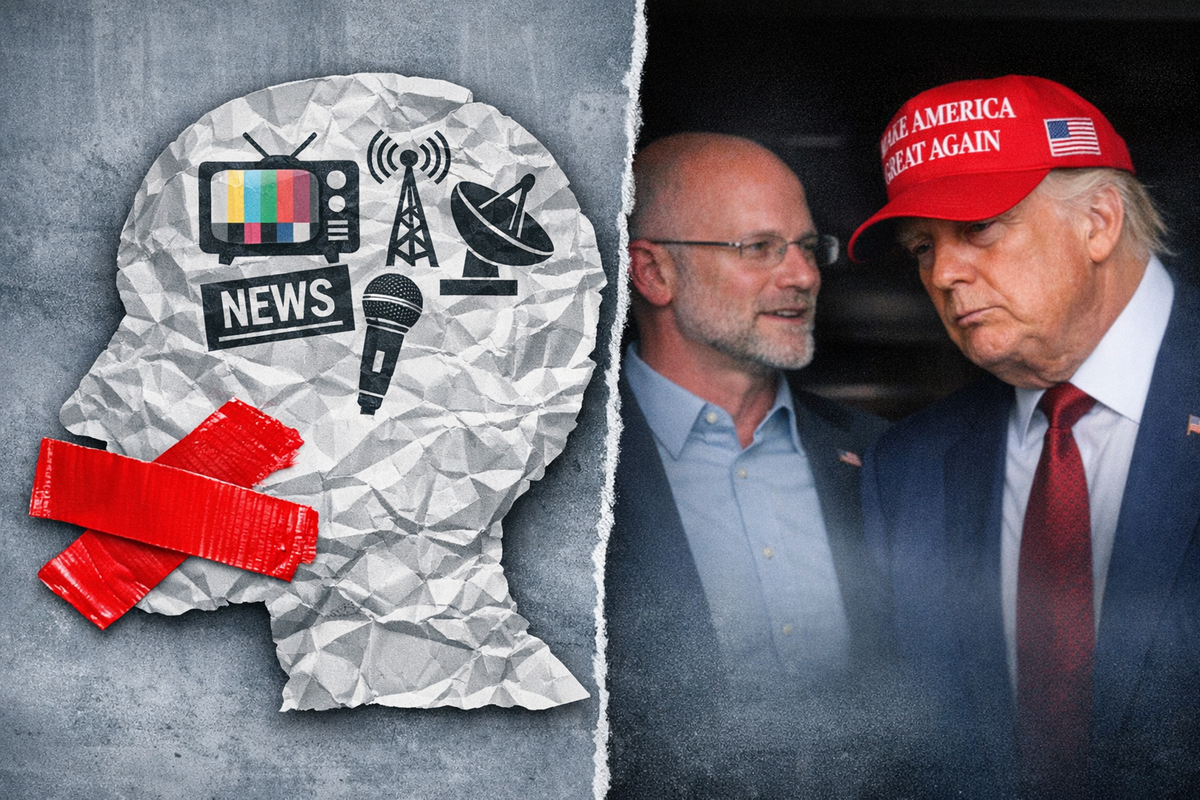
Yes, the President is mishandling a war. Yes, he is insisting—loudly and repeatedly—that everything is fine.
That alone would not be unprecedented. What is unprecedented is what happens next: when the press reports facts the administration doesn’t like, the response is no longer rebuttal or debate. It is coercion.
What should scare people right now is not any one report or controversy. It is that the administration is openly attempting to use the power of the state to silence voices it doesn’t like. That is the line that matters. And that line is being crossed in plain view.
Liberty’s Lens is entirely reader‑supported. We don’t answer to corporate masters deciding what we say or what we cover.
If you find our work valuable, please consider upgrading to a paid subscription. You can take 20% off with this coupon — and support independent media for about the price of a coffee per month.
Thank you to every reader who shares our work and helps it reach new audiences. We couldn’t do this without you. We love you all.
1. What Happened
The episode began with reporting by The Wall Street Journal and other outlets that five U.S. refueling tanker planes were struck and damaged at Prince Sultan Air Base in Saudi Arabia during Iranian missile activity. The reporting was careful: the aircraft were damaged, not destroyed.
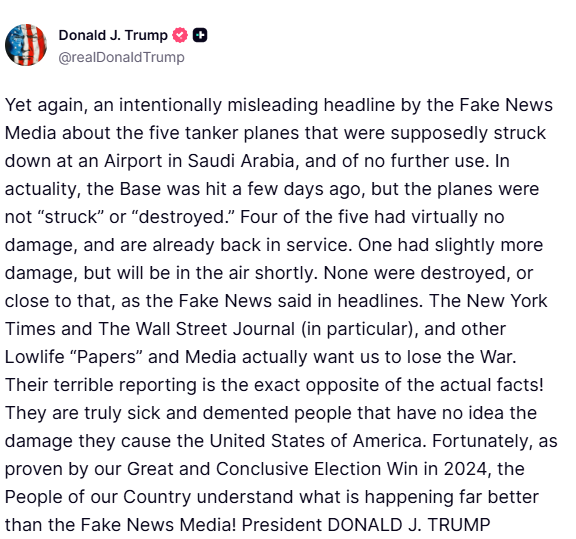
On March 14, 2026, President Trump responded on Truth Social, accusing the Wall Street Journal, the New York Times, and others of running an “intentionally misleading headline.” He insisted that four of the five planes sustained “virtually no damage” and were already back in service, and that none were destroyed “or close to that.”
This was not presented as a routine disagreement. Trump framed the coverage as sabotage during wartime, claiming certain outlets “actually want us to lose the war.” (CNBC)
Disputes over facts happen. Presidents argue with headlines. That, by itself, is not unusual.
What followed was.
2. Brendan Carr’s Intervention: Regulation as Intimidation
Shortly after Trump’s post, FCC Chair Brendan Carr reposted it on X and issued a statement that transformed a rhetorical attack into a regulatory threat.
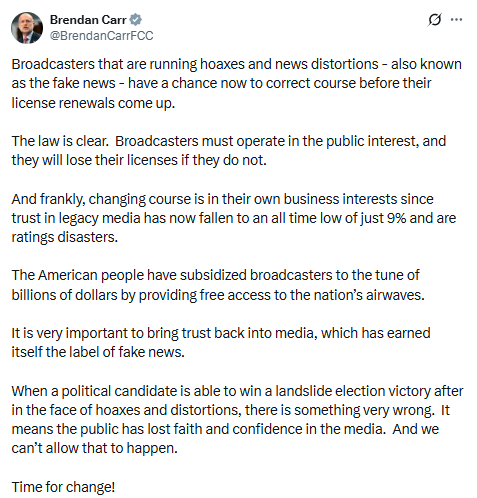
Carr warned that broadcasters running “hoaxes and news distortions” must “correct course” ahead of license renewals or risk losing their right to broadcast. In doing so, he repeatedly framed the media as untrustworthy, pointing to polls showing confidence in legacy outlets at historic lows and arguing that the press had “earned” its reputation as “fake news.”
He did not identify any false reporting. He did not cite FCC findings. He did not open an investigation. Instead, he treated declining public trust as justification for punishment—evidence that the government was entitled to step in and impose consequences. (CBS News)
Most alarming of all, Carr suggested that Trump’s election victory itself was proof that the media had engaged in hoaxes. In other words: because Trump won, critical reporting about him must have been false.
That logic is completely upside down. Elections do not determine truth. They do not retroactively resolve factual disputes. And they absolutely do not grant the government authority to censor the press.
This is what authoritarian systems look like. The state does not argue with the media—it controls it. It says: we don’t like how you’re describing reality, so we’ll revoke your right to speak.
That is exactly what’s being threatened here, with “public interest” functioning as a fig leaf for political obedience.
3. Why This Is Not a Media Error Story
Let’s be clear about the underlying reporting: it wasn’t wrong. The planes were damaged. Headlines did not claim they were destroyed. The administration can quibble over emphasis or framing, but that’s a minor disagreement.
And now disagreement itself is being treated as a licensing violation.
That is the key shift. Accuracy is no longer the standard. Compliance is.
4. Why This Moment Is Especially Alarming
This is not a campaign surrogate mouthing off. This is the sitting chair of an independent federal agency explicitly linking news coverage to license survival. (UPI | The Hill)
And it is happening during an active U.S. military conflict—precisely the moment when press scrutiny is most vital.
This marks a sharp escalation: wartime coverage being tied, explicitly, to regulatory punishment. That crosses from grievance into potential prior restraint.
When the FCC chair tells broadcasters they must “correct course” or risk losing their licenses, that is not criticism. It is a threat backed by the force of the state. It is the government asserting control over who gets to speak, who gets to broadcast, and under what conditions.
That is authoritarian behavior, full stop.
5. The Broader Pattern: “Reshaping the Media”
This episode does not stand alone—and it is not accidental. The administration is openly celebrating its campaign against independent media. The President has reposted a graphic boasting that he is “reshaping the media,” presenting the defunding of public broadcasters, the removal of journalists, forced settlements with networks, and selective regulatory enforcement used to pressure media outlets into compliance as proof of success. In this telling, press independence is not a democratic norm—it is an obstacle that has been overcome. (NBC News | The Wrap via Yahoo News)
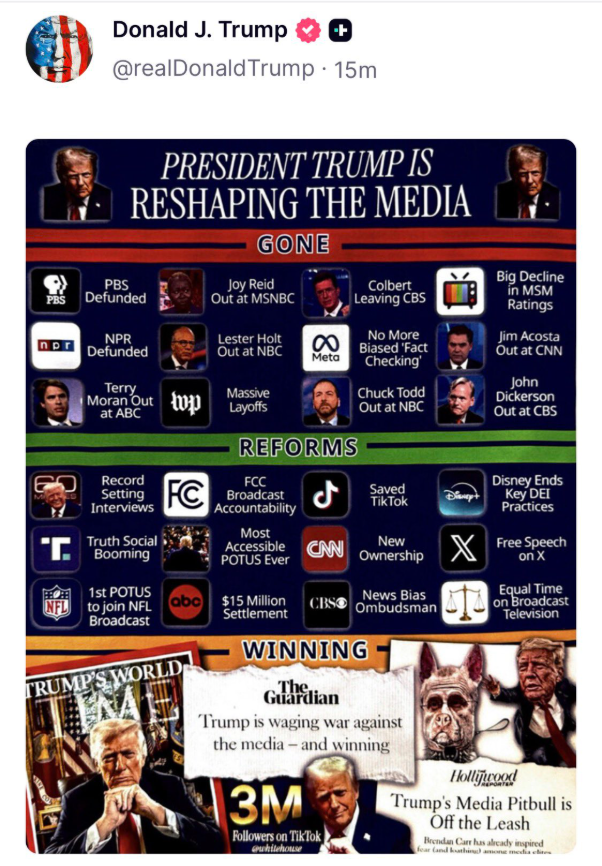
The message is unmistakable.
What makes this even more absurd is the right‑wing fiction—treated as settled fact—that the media operates as a unified, anti‑Trump monolith. It is a story told so often that it substitutes for evidence, even as the most powerful media platforms in the country are owned or run by Trump allies or sympathizers. Fox dominates cable news. Social platforms increasingly tilt his way. Major networks are being bought up by friendly billionaires.
And yet, we’re told the press is hopelessly biased—and must therefore be disciplined by the state.
For years, Trump and his allies have reinforced this narrative relentlessly, branding any critical reporting as “fake news,” regardless of accuracy, ownership, or audience size. The point has never been persuasion; it has been attrition—degrading public confidence until distrust becomes the background condition.
All of this is unfolding while the country is at war. Instead of focusing on strategy, escalation, and consequences, the administration is policing headlines, dissecting word choice, and punishing outlets for accurately describing events the government itself just boasted about.
If trust in the media has eroded, this is a big reason why. You cannot spend years calling journalists liars, poisoning the public against them, and then turn around and say: Look how little people trust you—now we’re taking your license.
That’s not accountability. That’s entrapment.
Support Independent Journalism!
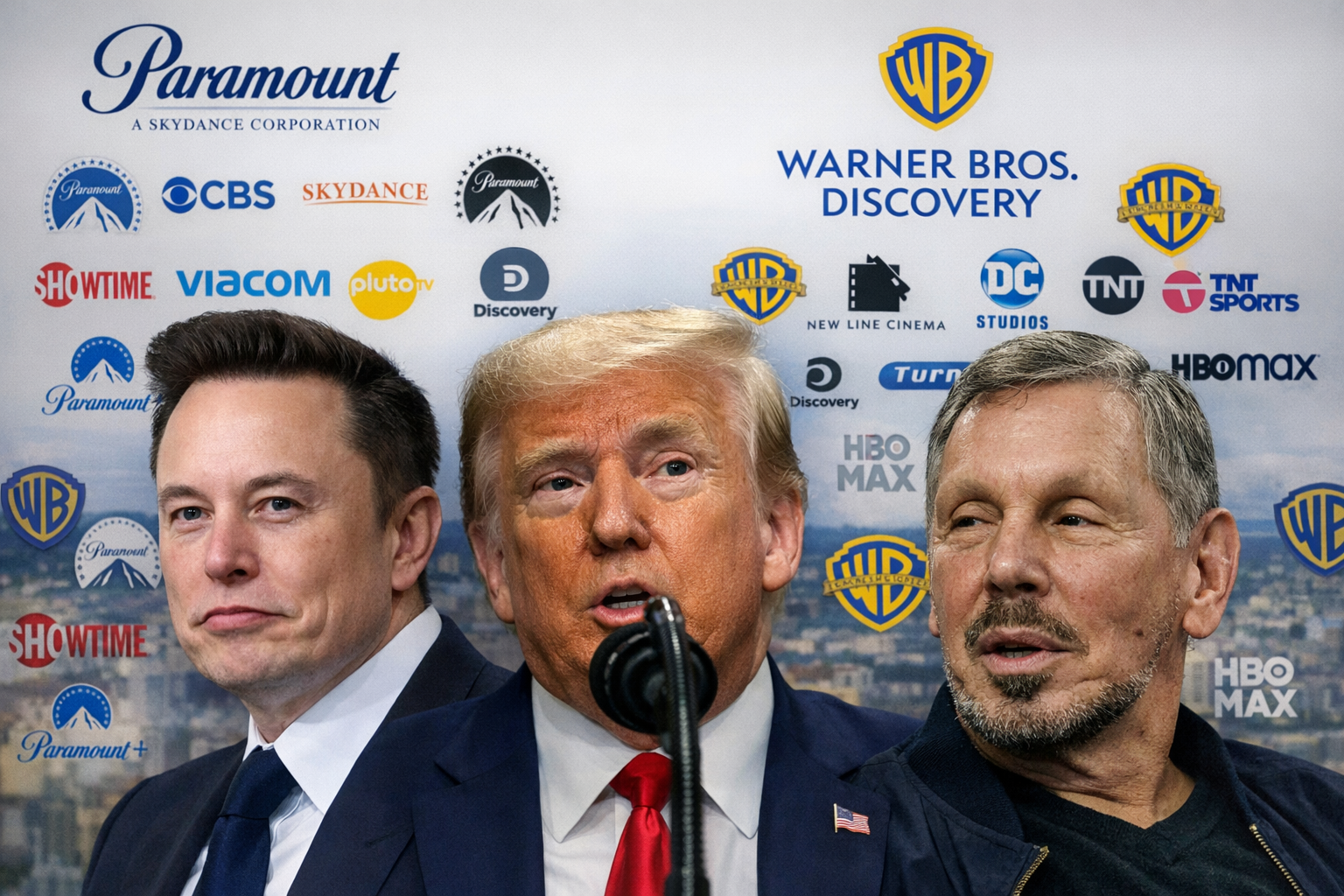
Look around: media consolidation isn’t subtle anymore.
A single ideological camp is amassing platforms—social networks, news outlets, streaming services—all under its banner. One by one, spaces for open dialogue are being converted into echo chambers.
But not independent media.
Liberty’s Lens is part of a growing movement of independent progressive voices refusing to be absorbed, censored, or silenced.
We publish what powerful interests would prefer you not see.
We ask the questions their platforms no longer allow.
We stay independent because independence is the last defense against narrative control.
👉 Join the resistance to media monopolization:
When you upgrade, you get:
✅ 20% off your annual subscription for the next year
✅ Full access to all premium reporting and commentary
✅ A direct role in sustaining independent media
Thank you for standing with independent media.
Together, we keep it alive.
6. Bottom Line
Taken together, this is not a spat over headlines. It is an emerging theory of governance:
Elections determine truth.
Regulators enforce it.
Dissenting media lose the right to exist.
That is why critics are calling this authoritarian in character. The danger has nothing to do with the merits of any particular claim—it lies in the precedent itself: state power used to coerce favorable wartime coverage by threatening silence.
The real test going forward will not be whether journalists get every detail right, but whether disagreement itself remains permissible. When regulatory pressure replaces rebuttal, when “trust” is invoked as grounds for punishment, and when wartime coverage becomes a loyalty test rather than an object of scrutiny, a free press may still exist in form—but not in function.
For readers who want the receipts
- Trump disputes reports on Iran-damaged U.S. tankers — (CNBC)
- Brendan Carr says broadcast licenses are not a “property right” — (CBS News)
- FCC’s Carr issues license threat over Iran war coverage — (UPI | The Hill)
- Trump is ‘Reshaping the Media’ — (NBC News | The Wrap via Yahoo News)
— Liberty’s Lens
This article is provided for public interest reporting and analysis. All external links open in a new tab and point to their original publishers.
© 2026 Liberty’s Lens. All rights reserved.