Trump Is Waging War on Americans in Blue States — and His Administration Just Admitted It in Court
We all pay into the same government. This administration has decided only their voters get anything back.
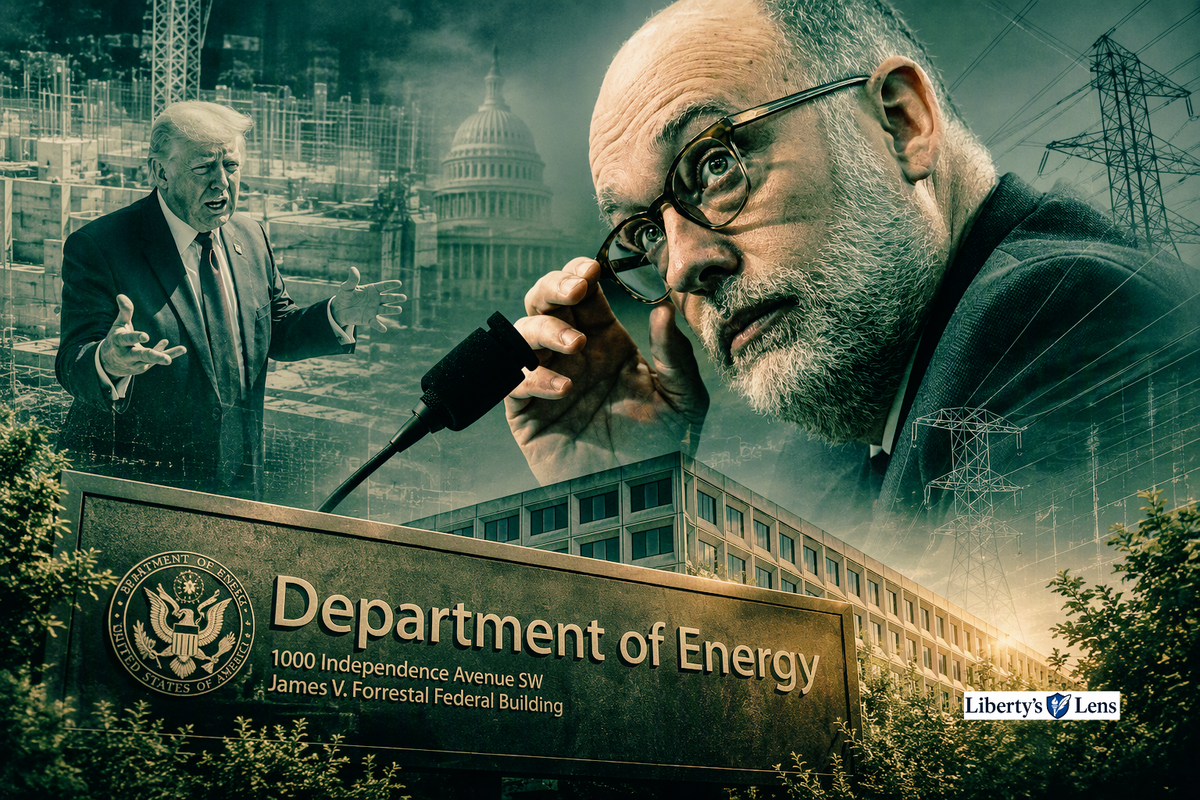
In a striking admission, lawyers for the Trump administration have now formally acknowledged, under oath in court filings, to pulling federal investments from states based solely on how they voted in the 2024 election — a move opponents say has all the hallmarks of a punitive act, one undertaken using taxpayers’ own money. This according to recent filings by the Department of Energy as part of early negotiations in a federal lawsuit brought by University of California researchers.
“With one exception, the 284 terminated grants had a recipient location and/or at least one place of performance in a state that awarded its electoral votes to Kamala Harris in the 2024 election and has two Democratic-caucusing Senators,” the filings read.
The Department of Energy had recommended a list of 624 grants for possible termination; the White House Office of Management and Budget then winnowed that list down to 284 — all but one located in the 16 blue states that voted against Donald Trump. The 340 grants left untouched belonged to states that cast their electoral votes for Trump or had at least one Republican senator.
The cuts were among a tranche of cancellations, announced in October, aimed at rolling back nearly $8 billion in funding for Biden-era alternative energy projects such as wind and solar — the very sort of cheap, homegrown power that foreign adversaries can’t blockade or embargo. The value of that kind of investment is playing out in real time abroad. In Pakistan, a consumer-led rooftop-solar boom has grown from almost nothing to nearly a fifth of the nation’s electricity. That shift has let the country avoid more than $12 billion in oil and gas imports and blunt a crisis it is otherwise acutely exposed to — Pakistan is among the nations most dependent on oil and gas moving through the Strait of Hormuz, the route choked off by the President’s war with Iran. In Spain, where wind and solar now supply 42% of the grid, households have been shielded from a roughly 60% spike in gas prices that the war triggered — their electricity bills barely moved, and actually dipped in April.
This is the very resilience those Biden-era projects were meant to build here. Few would have been finished in time to cushion these states from the current shock, but that isn’t the point. They were cancelled not because they wouldn’t have worked, but because of who they would have helped.
“DOE accepts that the inclusion of grants in the October notice tranche was based solely on the political identity of the grant recipient’s state, i.e., whether the recipient’s location and/or place of performance was in a Blue State or a non-Blue State.”
Yet the DOE insisted at the time that the cuts would “protect taxpayer dollars and expand America’s supply of affordable, reliable, and secure energy.” For whom, exactly? On the evidence, affordable energy is a reward for the President’s supporters — and letting it reach his opponents is the thing to be guarded against.
Liberty’s Lens is entirely reader‑supported. We don’t answer to corporate masters deciding what we say or what we cover.
If you find our work valuable, please consider upgrading to a paid subscription. You can take 20% off with this coupon — and support independent media for about the price of a coffee per month.
You can also gift a paid subscription to a friend who’d appreciate what we do.
Thank you to every reader who shares our work and helps it reach new audiences. We couldn’t do this without you. We love you all.
The Trump Narrative
Each of the 16 states affected by these cuts had either a Democratic state legislature or a Democratic governor.
At the time, the Department of Energy said it had canceled the projects because they wouldn’t meet the nation’s energy needs and “were not economically viable.” Trump’s Energy Secretary, Chris Wright, previously testified to Congress that the decision to terminate the grants was not political:
“So let me restate again: all of the 2,270 projects we evaluated were not evaluated in any way, shape or form based on where they were. … And all of the people that worked on our project review process did not take into account any politics in the evaluation of these projects,” he told the House Appropriations Committee in April of 2026.
And then, going further, he called the accusation that the decisions were political “bull-s***,” reiterating that “no decisions were made on politics” in his June 10th testimony before the House Science, Space, and Technology Committee.
Russell Vought, the White House budget director who oversaw the terminations, insisted that he was simply paring back Biden-era federal grants the White House considered wasteful — part of what he branded a “Green New Scam.”
Those claims are directly contradicted by the recent Department of Energy filings, which concede that the cuts were not based on “any programmatic, statutory, cost-reduction, or performance-based factor.”
Here too, benefits to blue states are branded wasteful — a “scam” — while identical projects roll on in red states, funded from the same taxpayer pool.
This Was Never Just About Energy
While the admission was startlingly candid, it builds on prior claims by the administration that leveraging federal budget disbursements to reward political allies or punish opposition states is “constitutionally permissible.”
In December, it argued this exact point. Two months after officials in blue states accused the White House of “mafioso tactics,” administration lawyers defended precisely this sort of political targeting in court, claiming that “consideration of partisan politics is constitutionally permissible, including because it can serve as a proxy for legitimate policy considerations.”
Federal courts have not been persuaded. In January, a U.S. district judge ruled that the administration’s targeting of clean-energy grants violated the Constitution’s guarantee of equal protection, writing that officials “freely admit that they made grant-termination decisions primarily — if not exclusively — based on whether the awardee resided in a state whose citizens voted for President Trump in 2024.” As the plaintiffs put it, and the court agreed: “There’s no federal funding exception to the Equal Protection Clause.”
This recent filing by the DOE is really just the latest revelation of this sort of partisan targeting in Trump’s second-term administration. The examples go far beyond Energy Department grants for wind and solar.
The Department of Health and Human Services froze $10 billion in childcare and family assistance across five blue states over unproven fraud allegations.
Disaster Aid Denials: A POLITICO analysis of some 2,500 disaster declarations found that Trump has approved 89% of aid requests from states with a Republican governor and two Republican senators, but just 23% from their Democratic counterparts — the sharpest partisan gap in FEMA’s history. In July, that pattern hit home for four blue states — New York, New Jersey, Massachusetts, and Rhode Island — when the administration denied $227 million in aid after a record-setting February blizzard, just two days after approving relief for nine Republican-leaning states.
Transit Rule Reviews: Slicing or pausing billions in transit funding — including $2.1 billion for Chicago’s Red Line extension and modernization projects — under the guise of reviewing “race-based contracting” or DEI policies.
This is no longer a matter of interpretation. With the courts, the record, and the administration’s own filings all pointing the same direction, Democratic lawmakers have called for bipartisan action against what they see as the open weaponization of the federal budget against American citizens.
Sen. Patty Murray (D-WA) and Rep. Marcy Kaptur (D-OH) released a statement that read in part:
“Secretary Wright swore up and down for months that these project terminations had absolutely nothing to do with politics, and now his lawyers are declaring that, in fact, politics was the only consideration. Weaponizing the federal government like this is outright un-American, and it’s hardworking families already struggling with sky-high costs who are suffering the consequences of this corrupt abuse of power.”
Representatives for the Energy Department reiterated Friday that its decisions to terminate the grants were not political, and said the court filing did not change that assessment:
“There is no contradiction, and any suggestion of a contradiction is a misrepresentation of the court filing,” spokesman Ben Dietderich told The New York Times.
The distinction the department is leaning on is a narrow one: the original list of 624 grants, DOE says, wasn’t sorted by politics — it was OMB’s decision to cut it down to 284 that was. But that’s a defense of process, not of outcome. By the department’s own admission, the grants that actually died were chosen for one reason: the states they were in voted the wrong way.
A Question of Federal Power
Strip away the subject matter, and what remains is a question about the nature of federal power itself. The money at stake here isn’t the President’s to spend as he pleases, nor even the executive branch’s — it is federal money, drawn from taxpayers in all fifty states and appropriated by Congress for national programs. A family in Sacramento pays the same federal taxes as a family in Amarillo. When an administration decides that the Sacramento family’s dollars may fund projects only in states that voted the right way, it isn’t practicing fiscal restraint. It is deciding that some citizens are entitled to less from their own government because of how their neighbors cast a ballot. That is the principle now being tested — not in energy policy, but in the far older promise that Americans stand equal before their government.
The central question in this story is no longer whether politics played a role. The Department of Energy’s own court filing acknowledges that political identity was the determining factor in which grants were killed. What remains is a question only the public can answer: should a president be allowed to reward the states that back him while stripping federally funded benefits from those that don’t?
Related reading:
- Guilty by Association: NSPM-7 and the Criminalization of the American Left
- Guilty by Association: How the Trump DOJ is Weaponizing Prosecutions to Criminalize Dissent
- Free Speech Under Threat: White House Enemies Lists and the Rise of Media Capture

The Trump regime’s authoritarian project depends on misinformation and disinformation. It thrives in darkness and resists scrutiny. That’s why exposure matters — and why independent media does too.
A free society depends on a free press. Not one shaped by access, intimidation, or political loyalty, but one willing to report what those in power would rather keep hidden.
Liberty’s Lens exists for that purpose. We’re independent, reader‑supported, and committed to reporting without fear or favor.
If that work matters to you, consider supporting it by subscribing — free or paid. Paid subscriptions directly fund our reporting, and right now you can subscribe at 20% off with this coupon, roughly the cost of a monthly coffee.
If a subscription isn’t workable at the moment, one‑time contributions are a meaningful alternative. And whether or not financial support is possible, sharing this work matters — it’s how reporting like this reaches people it would otherwise be kept from.
Your support keeps independent journalism alive.
Find us on X, Blue Sky, and Facebook. Wherever you are, that’s where we want to be.
For readers who want the receipts
- The DOE court filing conceding the cuts were political (as reported by the NYT) — (The New York Times)
- Federal judge rules the grant terminations unconstitutional — (AP News)
- DOJ argues partisan targeting is “constitutionally permissible” — (MSNBC)
- Pakistan’s rooftop-solar boom now supplies roughly a fifth of its electricity — (World Resources Institute)
- Solar let Pakistan avoid $12+ billion in oil and gas imports amid the Hormuz crisis — (CREA)
- Spain’s renewables shielded households from Iran-war gas-price spikes — (The Guardian)
- How some countries were better prepared for this energy crisis — (Carnegie Endowment for International Peace)
- FEMA approved 89% of red-state disaster requests vs. 23% for blue states — (POLITICO)
- $10 billion childcare and family-aid freeze across five blue states — (CNBC)
- $2.1 billion Chicago transit freeze over “race-based contracting” — (NPR Illinois)
— Liberty’s Lens
This article is provided for public interest reporting and analysis. All external links open in a new tab and point to their original publishers.
© 2026 Liberty’s Lens. All rights reserved.