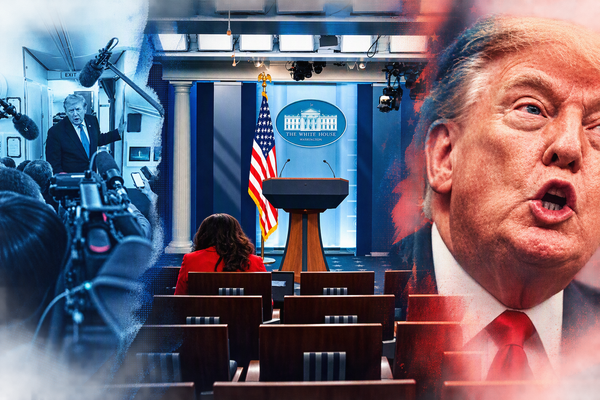
When the Machine Works: Inside the Royal Court of Trump 2.0
Loyalty over truth, performance over accountability, and a presidency designed to keep moving until something stops it.

There’s a mistake people keep making about Trump’s second term: they keep looking for the same chaos as Trump 1.0.
The first term had its own kind of disorder—rival factions, constant leaks, and a parade of officials who acted as speed bumps or guardrails. That messiness produced daily drama, but it also produced friction. A lot of the time, Trump wanted to do something—sign it, fire it, deploy it—and someone inside the building said no, slow down, don’t, or at least: not like that.
This time is different.
Not because the president has changed, but because the machinery around him has.
In Trump 2.0, the White House increasingly looks like two systems stacked on top of each other: a disciplined staff structure designed to execute, and a performative loyalty “court” designed to please. The point isn’t that nobody argues. The point is that the argument isn’t meant to stop the train. It’s meant to keep it from derailing in public.
And that has consequences—especially when the same instincts shaping domestic governance are now being used as a template for foreign policy.
Please, just a moment of your time...
Liberty’s Lens is entirely reader‑supported. We don’t answer to corporate masters deciding what we say or what we cover.
If you find our work valuable, please consider upgrading to a paid subscription. You can take 20% off with this coupon — and support independent media for about the price of a coffee per month.
If you've been thinking about upgrading to paid to support the work of Liberty's Lens, now is the time. Upgrade and save.
If a subscription isn't in the budget right now, a one time contribution, any amount, is always appreciated.
Thank you to every reader who shares our work and helps it reach new audiences. We couldn’t do this without you. We love you all.
The staff state: discipline, throughput, and a narrower set of veto points
Start with what’s most visible once you stop looking for leaks: the West Wing itself is more structured.
Chief of Staff Susie Wiles sits at the center of that discipline. In unusually candid, on-the-record interviews with Vanity Fair, Wiles describes a small “core team” and a governance style that does not romanticize guardrails; it emphasizes function, process, and getting the president’s agenda through the system. That’s what chiefs of staff are supposed to do—be the operating system for a presidency—but the scale of her access and the portrait of internal power in those interviews make one thing clear: if you’re trying to understand what gets to Trump, when it gets to him, and how the White House avoids self-inflicted collapse, Wiles is a key node. (Vanity Fair)
A disciplined West Wing doesn’t mean a wise one. It means fewer internal veto points, fewer people who see their job as protecting institutions from the president, and more people who see their job as helping the president do what he wants—fast.
That’s the core upgrade Trump’s team made after the first term: competence at execution.
The policy engine: Stephen Miller as accelerant
If Wiles is the operating system, Stephen Miller increasingly looks like the applications layer.
The Atlantic has reported in detail on Miller’s operational influence—describing him as a figure who turns the president’s most incendiary impulses into policy and drives cross-agency pressure around enforcement priorities. (The Atlantic)
PBS NewsHour independently frames Miller as a central architect of the administration’s crackdown whose influence extends beyond immigration into foreign policy. That matters because it’s corroboration from outside The Atlantic’s ecosystem: different newsroom, different sourcing chain, similar conclusion about his footprint. (PBS NewsHour)
This is one of the defining mechanics of Trump 2.0: Trump supplies instinct, grievance, spectacle, and raw will. Miller supplies implementation logic—how to turn the mood into the memo, the rant into the rule, the headline into the directive.
When you combine that kind of operator with a White House designed to reduce friction, you get what I’d call “dangerous competence”: fewer melodramatic internal restraints and more capacity to act quickly, across agencies, with fewer people empowered to say no.
The court: praise, proximity, and governance as performance
Now layer in the second system: the visible “court.”
You don’t need a leak to see it. You can watch it.
Televised cabinet meetings have become a recurring stage where cabinet secretaries and senior officials perform deference and praise as part of the public rhythm of governance. The structure is consistent: the president presides, the cabinet testifies—often less like independent stewards of agencies and more like courtiers demonstrating loyalty. (C‑SPAN | Rev transcript)
This isn’t just aesthetics. It creates incentives.
In a court system, information flows toward the person who grants favor. And the people who want favor learn quickly what gets rewarded: praise, certainty, aggression, and a willingness to treat reality as optional if it helps the story.
Truth quickly becomes a secondary concern. Not necessarily because everyone is lying all the time, but because the system rewards effect over accuracy. And if the president himself treats claims as transactions—tools to win the minute—then correction becomes risky. Why puncture Trump’s balloon full of hot air if your job is to keep it afloat—or worse, to add your own hot air to the mix?
The Minneapolis stress test: recalibration within the system
If you want to see how these two systems interact under pressure, look at Minneapolis.
After the killing of Alex Pretti, multiple outlets reported a sharp shift in the White House posture: the administration’s initial rhetoric—promoted by senior officials—ran into video evidence, public backlash, and bipartisan discomfort. ABC News reported the White House distancing the president from specific characterizations and emphasized Trump’s decision to dispatch Tom Homan to Minnesota, explicitly bypassing the normal chain of command. CNBC similarly reported a tone shift and contrasted the White House’s later posture with early claims that were disputed by video. (ABC News | CNBC)