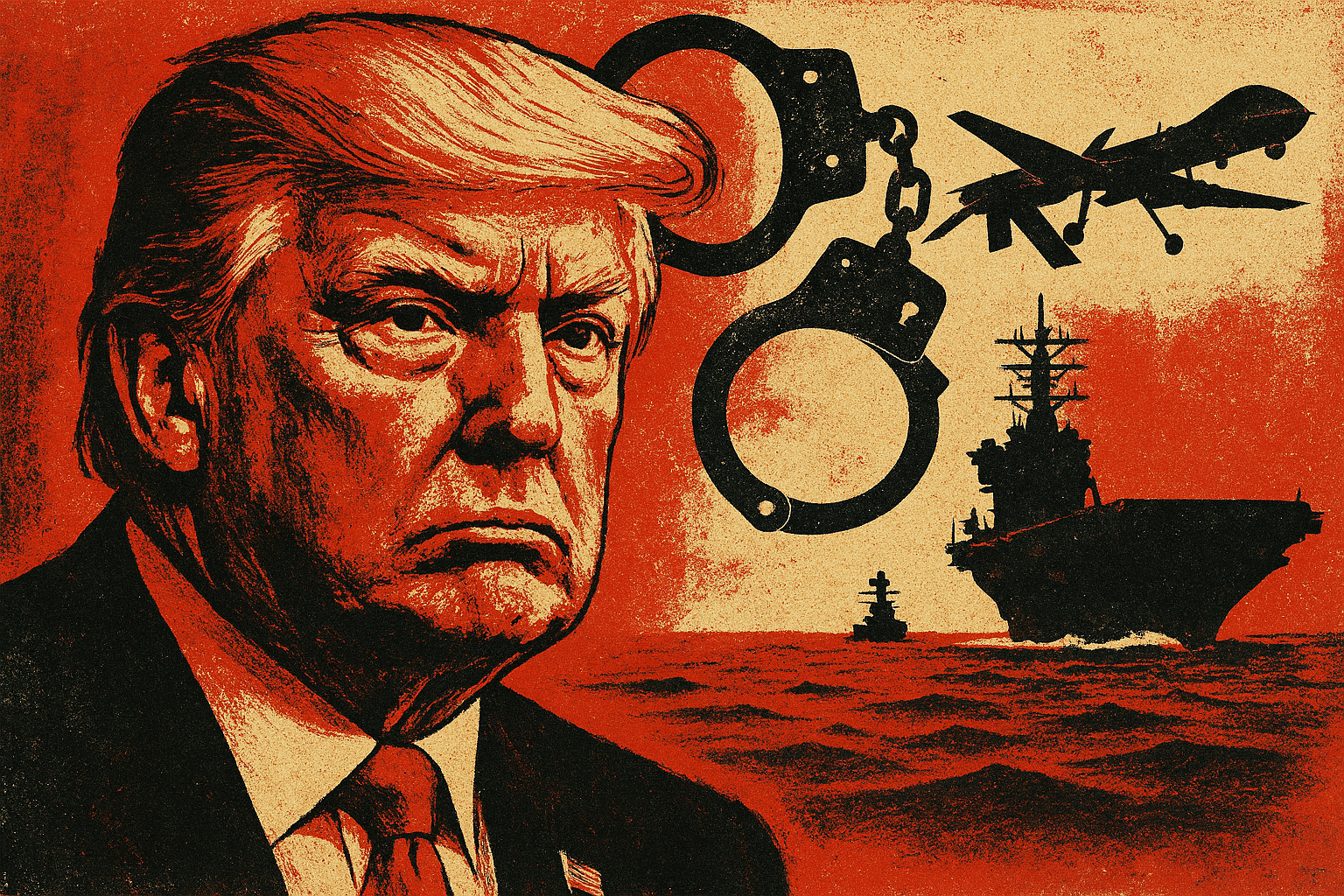
From Safety Nets to Zip Ties: What MAGA Calls ‘Democrat Programs’
When programs that keep families healthy are dismantled, the state’s muscle moves in. Welcome to the new governing philosophy.
What does “Democrat program” even mean?
In this shutdown fight, MAGA politicians—including Trump—keep promising to cut them. But what are they really talking about? Programs that track outbreaks? That keep kids learning? That make health care affordable? Aren’t those for everyone? When a government starts labeling basic services as partisan, it’s not just budgeting—it’s a worldview. And that worldview is shaping what gets funded, and what gets burned down.
I. The Shock of Permanent Layoffs
“Reduction in force” sounds clinical. It’s Washington’s euphemism for permanent layoffs. In past shutdowns, federal workers were furloughed and returned when funding resumed. This one is different: thousands of RIF notices went out across seven departments—with the heaviest hits at Health and Human Services (including the CDC) and the Department of Education—an extraordinary escalation in the middle of a funding lapse (USA TODAY | The Hill).
At the CDC, notices touched outbreak-response and immunization teams and even the editorial lifeline of the Morbidity and Mortality Weekly Report, before hundreds of letters were frantically rescinded—a sign of chaos, not mercy (CBS News | The Hill).
“Nonessential, then gone. RIFs don’t pause government—they amputate it.”
At Education, the cuts landed in places families feel first: the Office of Special Education and Elementary & Secondary Education—functions that help states enforce the law and keep kids on track. Nearly a fifth of the agency’s workforce got pink slips as the shutdown dragged on (USA TODAY | PBS/AP).
Asked who would be targeted, the President said the quiet part out loud: the layoffs would be “Democrat-oriented” and would “only cut Democrat programs” (NBC News (video) | NPR/WUSF). Federal workers, necessary for functions Americans rely on day-in and day-out are being used as leverage to end this shutdown fight. MAGA does not seem to care if Americans suffer, the cruelty is the point. But what is this fight even about to begin with?
II. “It’s About Health Care”
Pressed on the question of the shutdown fight, the President didn’t hedge:
“We have a negotiation going on … and I’m talking about good things with regard to health care.”
That’s not a stray remark—it’s the clearest admission yet that this standoff is about whether millions of Americans keep affordable coverage or watch premiums explode (The Hill | AP via MSN).
Why the timing here matters:
Open enrollment begins November 1. Insurers are already filing rates assuming the enhanced ACA premium tax credits will vanish if Congress waits. Those credits—expanded under pandemic relief—are the reason a 60-year-old in rural Texas pays $150 a month instead of $900. Lose them, and the math flips overnight.
“Later” on Capitol Hill often means never for families whose bills arrive first.
Hospitals see the cliff coming too: analysts warn of $32 billion in lost revenue and $7.7 billion in unpaid medical bills if subsidies lapse, with rural facilities at greatest risk (CNBC | Fiscal Times). For many American families, this isn’t a policy abstraction—it can literally be the difference between life and death.
And here’s the kicker: even some Republicans admit the stakes. A few have floated short-term extensions, but party leadership insists the government must reopen first. Democrats see reopening first as a trap. After months of rescissions and impoundments—deals made, then clawed back—they’re unwilling to surrender the only leverage they have. For lawmakers trying to protect affordable care, that’s not negotiation—it’s capitulation.”
III. The Wallet Hit
If health care costs spike and safety nets fray, the squeeze on household budgets becomes unbearable.
A) The ACA Subsidy Cliff
If Congress lets enhanced ACA premium tax credits expire at year’s end, out-of-pocket premiums for subsidized enrollees will more than double on average in 2026—a shock most small business owners, gig workers, and early retirees cannot absorb (CNBC/KFF | The Fiscal Times).
“It’s not a theoretical cliff. It’s a bill with your name on it.”
This would be catastrophic for American families already under immense pressure from rising prices. We’re left to wonder, why is it that only Democrats seem to care here?
Sidebar: What Happens If ACA Subsidies Vanish?
Premiums for subsidized enrollees double on average in 2026
Millions lose coverage; rural hospitals face $32B revenue loss
Unpaid medical bills projected at $7.7B
No GOP plan to offset costs—families absorb the hit
B) Medicaid Work Requirements—Paperwork as a Weapon
Alongside the looming ACA subsidy cliff, another fight centers on so-called Medicaid work requirements—a policy critics call a cut by another name. Arkansas tested these rules in 2018–19, and the results were stark: more than 18,000 people lost coverage, with zero employment gains. Losses weren’t driven by refusal to work—they were driven by red tape (Urban Institute | CBPP).
Consider Adrian McGonigal, a poultry worker with COPD whose Medicaid coverage paid for the medications that kept him breathing. He missed a reporting step he didn’t understand; at the pharmacy, he learned he was uninsured. Without meds, his disease flared. Hospital bills followed. So did lost work—and then a lost job (NC Justice Center, citing PBS NewsHour).
McGonigal died of a heart attack just days before Thanksgiving in 2024. He was 46—a working-class American whose only mistake was failing to navigate paperwork designed to strip away care. This is the future MAGA envisions: a country where countless more go without essential coverage.
He was one of 18,164 Arkansans dropped under work-reporting rules—roughly a quarter of those subject to the policy. And here’s the thing: studies later showed most were still eligible or exempt, meaning coverage was lost because of bureaucracy, not because they failed to qualify. The policy didn’t boost employment—it just stripped health care from people who needed it most. And for what? To kill a so-called “Democrat program.”
“McGonigal’s death wasn’t an anomaly—it was a warning.”
C) Medicare Telehealth Rolls Back
Pandemic‑era telehealth coverage for Medicare also expired during the shutdown, cutting off access for homebound seniors unless Congress acts (CNBC). Yet another ‘Democrat program’, beneficial to hard working Americans but of little interest to increasingly out-of-touch MAGA politicians.
D) Tariffs as a Middle-Class Tax
These increases to healthcare costs could not come at a worse time for average Americans, who are already increasingly finding it difficult to make ends meet. Tariffs marketed as cost‑free “toughness” are landing directly on household budgets. Analyses show U.S. consumers are already eating more than half of the tariff costs; economists project a persistent pass‑through into prices (NBC News/Goldman Sachs | Penn Wharton Budget Model). This is part of what makes this all so urgent, cost increases are further straining budgets already pushed to the breaking point.
IV. Authoritarian Drift
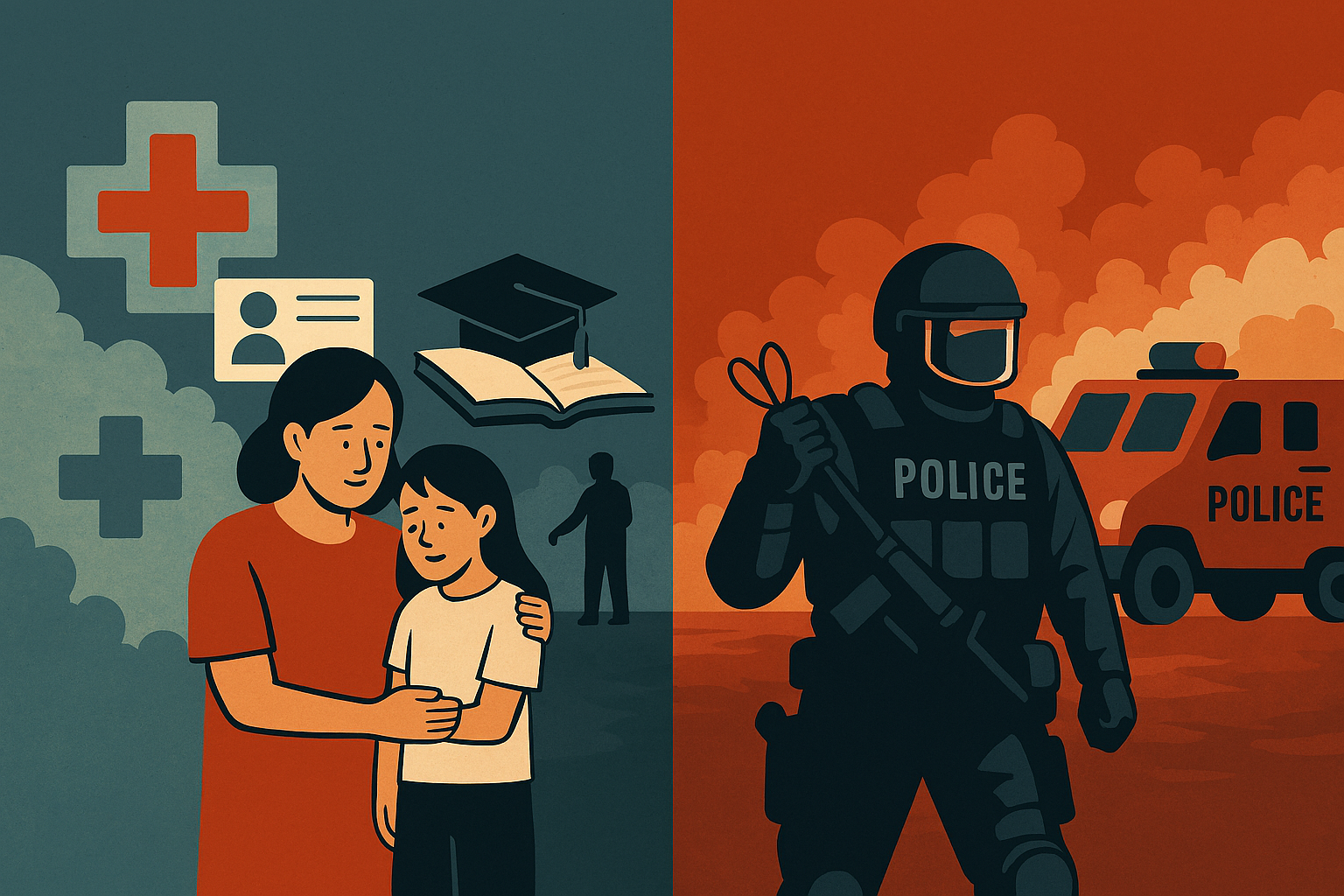
While cuts are being made to programs that benefit everyday Americans, the government finds endless money for force—raids staged like reality TV, influencers in tow, agitprop packaged for social feeds.
When the economic squeeze fails to break resistance, the state’s muscle steps in.
A) Masked Men, Unmarked Vans
Across multiple cities, federal agents—often masked and without visible identification—have conducted street and courthouse detentions that civil-rights groups warn blur the line between lawful arrest and public abduction (Center for American Progress | LA Times via Yahoo).
B) A Pastor Shot While Praying—On Video
In suburban Chicago, rooftop agents fired pepper‑ball rounds into a crowd, striking Rev. David Black—collar visible—as he prayed outside an ICE facility. He and journalists sued; a federal judge temporarily restricted certain uses of force against faith‑based demonstrators. DHS officials say protesters blocked operations; witnesses and plaintiffs dispute that (WGN‑TV | The Independent).
“He was praying for the officers when the shot came.”
C) South Shore, After Midnight
In Chicago’s South Shore, a pre‑dawn raid brought flash‑bangs, broken doors, and building‑wide detentions—including U.S. citizens—amid allegations that children were zip‑tied and separated. DHS framed it as a gang operation; residents describe a sweep that left families on the pavement for hours. (Details about minors being zip‑tied/transported vary across outlets and filings; we note these as allegations supported by eyewitnesses.) (The New Republic | Atlanta Black Star).
D) The $50,000 Takeout Bag
MAGA officials insist this is necessary—just law enforcement doing its job, even during a shutdown. They call it essential. But so are public-health teams that stop outbreaks, and educators who make sure kids with disabilities get the services they’re guaranteed. Affordable health care? Essential by any sane measure.
So let’s test their claim. Is this really about law and order, as they argue? Or is it about power? Because the pattern is hard to miss: the law comes down hard on some, while others act with impunity. When masked men can snatch citizens off the street and a White House aide walks away from a bribery sting, “law and order” starts to look less like a principle and more like a weapon.
Multiple outlets report that White House “border czar” Tom Homan was recorded accepting $50,000 in cash from undercover FBI agents in 2024 as part of a contracts‑for‑cash sting. After Trump took office, the investigation was closed; the White House says there was “no credible evidence” and Homan denies wrongdoing. House Judiciary Democrats are seeking the tapes. We present this as a disputed allegation supported by contemporaneous reporting and official denials (Reuters via Star‑Advertiser | USA TODAY).
E) “Take Care of This Little Gnat”
And looming over it all is the threat of more troops on our streets—more force, funded by the very people it’s aimed at. A military posture turned inward, waging a war not against enemies abroad but against half the country at home.
Speaking to Navy sailors, the President called Democrats “a little gnat” the military must “take care of.” Days earlier, he told top brass the fight is a domestic “war from within.” Courts in Illinois have begun to push back—enjoining certain deployments and requiring visible identification for federal agents in some operations—but the pattern is unmistakable: the state’s force is being normalized for use against domestic out‑groups (Yahoo News | Axios).
There’s money for this. There’s urgency for this. In the Trump administration’s calculus, this is what counts as essential. Not vaccines. Not classrooms. Not affordable care. Force.
V. The Throughline
Call a program that lowers premiums or protects public health or provides any necessary service to average Americans “Democrat,” and you can kill it without apology. Call the opposition a “gnat,” and you can point the state’s muscle at them without shame. The shutdown isn’t a pause—it’s a lever. It shrinks the parts of government that deliver broad benefits and shifts power toward coercive capacity. For those insulated by wealth, nothing changes. For everyone else, the costs stack up: higher premiums, higher prices, fewer services—and a door kicked in after midnight.
“When the social state shrinks, the security state fills the space.”
VI. What to Watch Next
- Open Enrollment (Nov 1): If Congress waits, households will lock into plans priced for vanished subsidies (KFF Health News).
- Courts & Constraints: TROs in Illinois limiting force and requiring identification in certain contexts; further litigation likely (Slate).
- Tariff Pass‑Through: Retailers can delay price hikes only so long; watch consumer‑goods CPI categories (NBC News).
- Medicaid Work‑Req Rollouts: Evidence from Arkansas and Georgia says coverage falls without job gains; waivers and federal rules will determine the scope (Urban Institute).
For readers who want the receipts
RIFs during the shutdown—over 4,000 across seven departments; CDC and Education hardest hit — (USA TODAY).
CDC cuts and chaotic rescissions (MMWR and immunization teams among those initially hit) — (CBS News | The Hill).
Education Department layoffs (~20% of workforce; special‑ed and ESEA divisions impacted) — (USA TODAY | PBS/AP).
“Democrat‑oriented” layoffs / “only cut Democrat programs” — (NBC News (video) | NPR/WUSF).
Trump on the shutdown fight: “good things with regard to health care” — (The Hill | AP via MSN).
ACA out‑of‑pocket premiums would more than double on average if enhanced credits expire — (CNBC/KFF | The Fiscal Times).
Medicaid work requirements: 18,000+ Arkansans lost coverage; no job gains — (Urban Institute | CBPP).
Human case: Adrian McGonigal (COPD), coverage loss → hospitalization → job loss — (NC Justice Center, citing PBS NewsHour).
Tariffs: consumers bearing >50% of costs; household and macro impacts — (NBC News/Goldman | Penn Wharton Budget Model).
Medicare telehealth flexibilities lapse during shutdown — (CNBC).
Masked/unnamed agents and accountability risks — (Center for American Progress | LA Times via Yahoo).
Rev. David Black pepper‑ball incident; litigation; TRO — (WGN‑TV | The Independent).
South Shore raid allegations (children zip‑tied; building‑wide detentions) — (The New Republic | Atlanta Black Star).
Tom Homan $50k allegation; investigation later closed; denials — (Reuters via Star‑Advertiser | USA TODAY).
“Gnat” remark to Navy; “war from within” framing to top brass — (Yahoo News | Axios).
— Liberty’s Lens
This article is provided for public interest reporting and analysis. All external links open in a new tab and point to their original publishers.
 Liberty's Lens