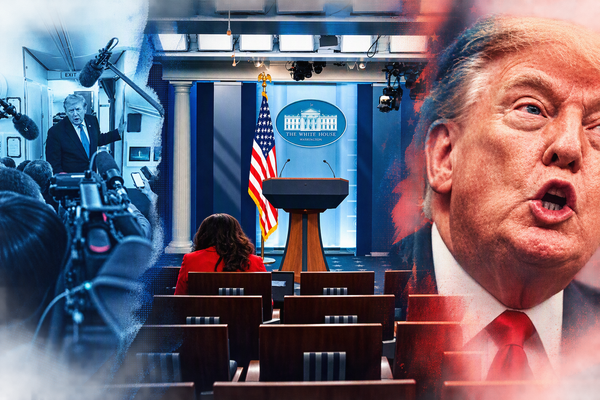
The Anatomy of a Constitutional Crisis: The Darker Possibilities That May Define the Remainder of Trump’s Second Term
Why These Emerging Flashpoints May Define the Fate of American Democracy
This publication is entirely reader‑supported. We don’t answer to corporate masters deciding what we say or cover. If you find our work valuable, please consider upgrading to a paid subscription—or gifting a paid subscription to a friend who’d appreciate what we do. Thank you to every reader who shares our work and helps it reach new audiences. We love you all.
One year into Donald Trump’s second term, the United States finds itself navigating political terrain more volatile than at any point in recent memory. The guardrails that once defined the boundaries between federal authority, state sovereignty, and civilian life are now visibly straining. We’ve made the case for optimism, and there are plenty of areas where things look worse than they may be in actuality, but there is also real cause for concern. Nowhere is this more apparent than in Minnesota, where Operation Metro Surge—a massive, federally directed immigration crackdown—has placed more than 3,000 ICE and Border Patrol agents into Minneapolis, a force five times larger than the city’s own police department. What was sold as a targeted enforcement initiative has escalated into a domestic flashpoint marked by civilian deaths, video‑verified contradictions of federal accounts, and state leaders openly accusing the administration of misconduct and deception. (cbsnews.com | politifact.com | usatoday.com)
 Liberty's Lens
The killings of Renee Good and Alex Pretti—both U.S. citizens—have become national symbols of something deeper than policy disagreements. They reveal a growing crisis of legitimacy: federal agents blocking state investigators from accessing a crime scene, courts issuing emergency orders to preserve evidence, and state and local governments suing the federal government to halt what they describe as an unconstitutional occupation. These are extraordinary developments in a country where intergovernmental conflict is supposed to be resolved through law, not force. (startribune.com | yahoo.com)
Legal scholars now warn that the dynamics unfolding in Minnesota echo the early stages of civil‑conflict simulations—war‑game scenarios in which a president attempts to override state authority, state officials resist, and federal deployments escalate into direct confrontation. Their concern is not hypothetical; these warnings arise precisely because the conditions those experts modeled—mass federal deployments, contested use of force, and state leaders mobilizing National Guard resources under political strain—now map onto real events. (nationofchange.org)
Against this backdrop, fears about election interference—long dismissed as fringe—have returned with new urgency. While federal law explicitly forbids deploying armed agents to polling places, statements from elected leaders, including Illinois Governor J.B. Pritzker, reflect a growing concern that such constraints may not deter extra‑legal action in a climate where norms have already eroded. And with Trump’s 2025 executive order attempting to centralize election authority within the executive branch—an act widely criticized as unconstitutional—the question is no longer whether democratic institutions are under stress, but how much stress they can endure before something fundamental breaks. (brennancenter.org | knewz.com | brookings.edu)
This article is not a prediction of collapse. It is an examination of the anatomy of constitutional crisis—the component parts, already visible, that together could form something far more consequential. America is not past the breaking point. But for the first time in decades, the outlines of such a point can be seen.
Federal Power Unbound — Operation Metro Surge
What began as a federal “immigration enforcement initiative” has expanded into something far larger and far more volatile. Operation Metro Surge now represents one of the most sweeping domestic deployments of federal law enforcement in modern U.S. history. Minneapolis is effectively hosting a 3,000‑agent federal presence—an occupation-scale deployment that dwarfs the roughly 600‑officer Minneapolis Police Department. (cbsnews.com)
But numbers alone don’t tell the story. The federal presence has been accompanied by a pattern of force that state and local leaders have openly condemned. In just the first three weeks, two U.S. citizens—Renee Good and Alex Pretti—were shot and killed by immigration agents. Both incidents ignited protests, not simply because of the deaths themselves, but because video evidence sharply contradicted DHS’s public claims about the victims’ behavior. The Trump administration asserted that Pretti was armed and threatening agents; bystander footage instead showed him holding a cellphone, not a gun. Minnesota Governor Tim Walz accused the administration of “gaslighting the entire country,” calling federal explanations not only false but defamatory. (politifact.com | usatoday.com)
The fallout has been immediate and intense. Local officials have demanded the withdrawal of federal forces; major sports teams and chambers of commerce have issued public pleas for de-escalation; and voters are watching their own city transformed into a testing ground for a new, more aggressive model of federal policing. What was promised as a targeted operation has become the epicenter of a national debate about the limits of federal power—and whether those limits are being deliberately pushed past their breaking point.
So the question on my mind, dear readers, is this: If figures like Stephen Miller and Vice President Vance are deliberately walking us toward conflict, what endgame do they imagine lies on the other side? Whatever that vision is, it’s nothing this country should welcome.
When Federal and State Power Collide
The United States is built on tension between federal authority and state sovereignty—but what is happening in Minnesota pushes far past the usual frictions. It marks the emergence of what legal scholars describe as early‑stage constitutional crisis behaviors: federal forces acting unilaterally, state officials attempting to assert their investigative rights, and both sides openly accusing the other of violating the law.
A particularly alarming development came when state investigators were physically blocked by federal agents from accessing the crime scene where Alex Pretti was killed. This forced Minnesota’s Bureau of Criminal Apprehension and the Hennepin County Attorney’s Office to seek—and win—a federal court order to prevent the Trump administration from destroying or altering evidence. That this order was necessary at all signals a profound breakdown in intergovernmental trust and protocol. (startribune.com)
Minnesota, Minneapolis, and St. Paul jointly filed suit to restrain the federal surge, arguing that Operation Metro Surge violates the 10th Amendment by commandeering local jurisdictions and trampling state sovereignty. Attorneys for the state made clear that these actions constitute “a day of reckoning” for constitutional order. (yahoo.com)
The academic community is sounding the alarm as well. The situation now unfolding bears an uncanny resemblance to civil‑conflict simulations conducted by the University of Pennsylvania’s Center for Ethics and the Rule of Law—exercises that modeled a president deploying federal agents into a city, attempting to overrule state resistance, and triggering cascading confrontations. Scholars involved in that simulation have stated that current developments in Minnesota track “uncomfortably close” to their modeled scenarios. (nationofchange.org)
“We’re in a position right now where we have residents that are asking the very limited number of police officers that we have, to fight ICE agents on the street … We cannot be at a place right now in America where we have two governmental entities that are literally fighting one another.
Why are we put in this position? … we have approximately 600 police officers … and there are approximately 3,000 ICE agents in the area. Three thousand.”
(politifact.com)
While neither Governor Walz nor local law enforcement has suggested they would initiate armed resistance, the situation is far more fraught than that simple fact suggests. Mayor Frey has publicly acknowledged that residents are urging Minneapolis police to “fight ICE agents on the street,” and he explained bluntly why that’s impossible: the city has roughly 600 officers, while federal authorities have deployed nearly 3,000 agents into the area — a disparity that makes any confrontation untenable.
The mere fact that such scenarios are being discussed at all — by residents, analysts, and national security scholars — underscores how far outside normal constitutional boundaries this moment has drifted.
Elections Under Pressure — The Fear of Federal Interference
If the Minneapolis crisis is the most visible sign of federal overreach, the realm of elections is where the stakes are highest. The United States has endured efforts by Trump to overturn election results once before—most dramatically in 2020. Today, fears of a renewed or expanded attempt are not speculative; they are grounded in documented history and statements from respected officials.