An Empty Chair in the Oval Office—and Who’s Sitting in Its Shadow
As the president drifts, unelected ideologues seize the wheel. The Oval Office may be asleep, but the agenda behind it isn’t.
Liberty’s Lens Investigative Series
A four-part deep dive into the vacuum of power and the agenda filling it.
Part I:
 Liberty's Lens
Part II:
 Liberty's Lens
Part III:
 Liberty's Lens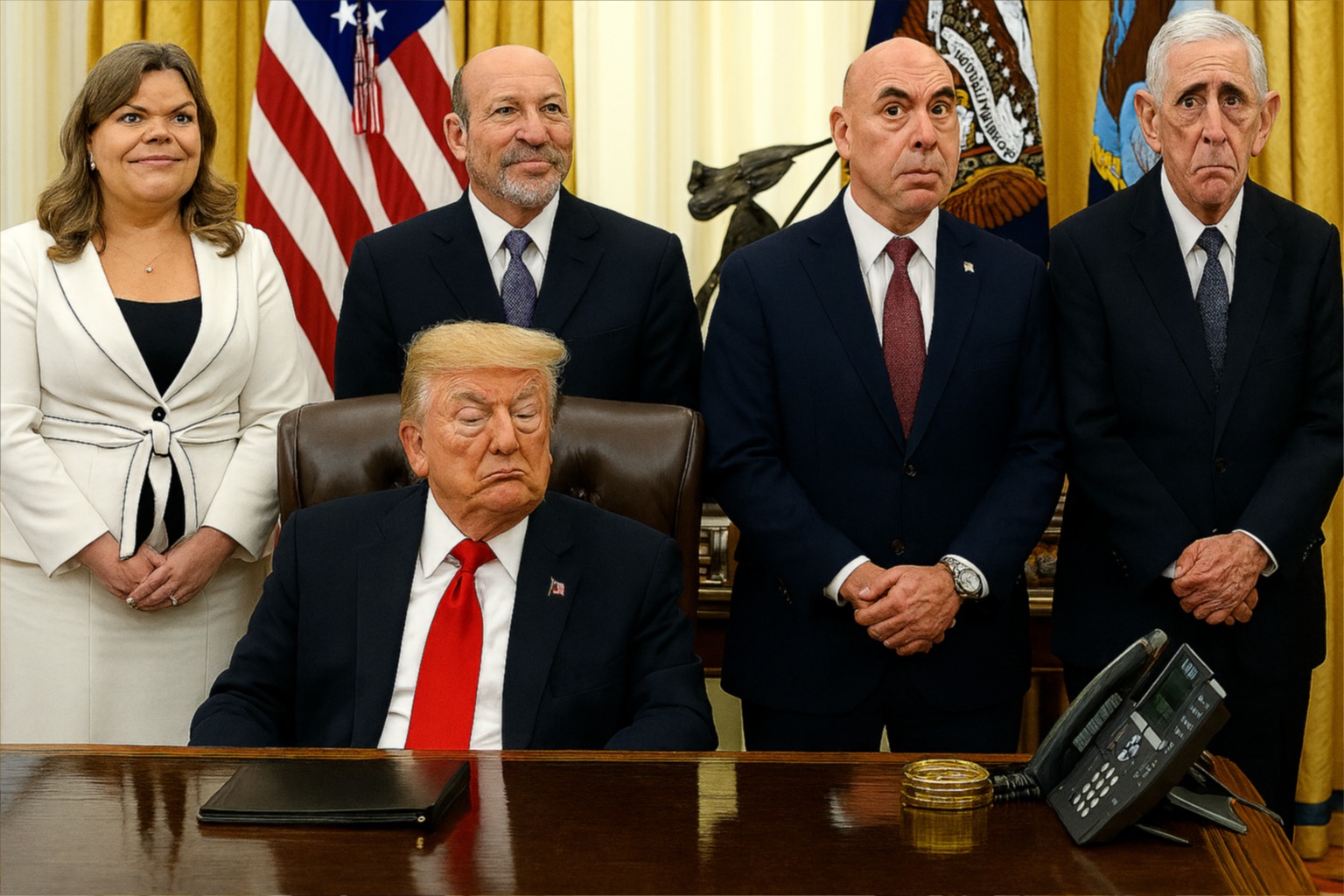
Part IV:
 Liberty's Lens
The most honest thing about the events of the past few weeks is how little interpretation they require. We all saw the same reel: the president, eyes closed behind the Resolute Desk during a live policy event; the same president staring into space as a guest collapsed just a few feet away; a ceremonial walk‑through in Tokyo where Japan’s new prime minister physically nudged and steered her American counterpart; and an Air Force One scrum where the president boasted about “acing” a cognitive test—complete with the stage‑one prompts “a tiger, an elephant, a giraffe.” None of this came from unnamed sources. It was public, on tape, archived by outlets and posted to social platforms for anyone to watch (Washington Post video | ABC News).
In Part I of this series, The Puppet Presidency, we mapped the mechanism: confusion meets control. In Part II, Remigration, we named the program that thrives in that environment. This chapter is about acceleration. What happens when the principal drifts and the room runs itself?
The Drift in Plain Sight
Domestic stage
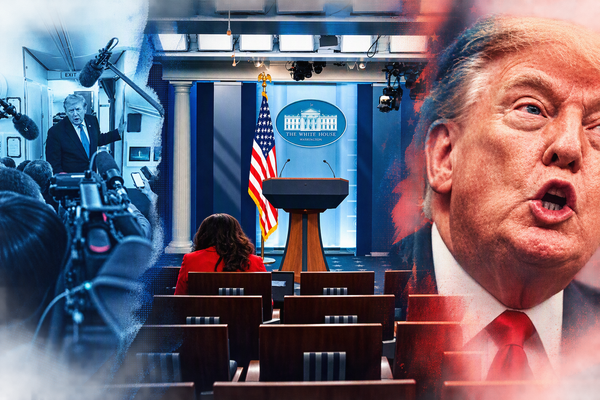
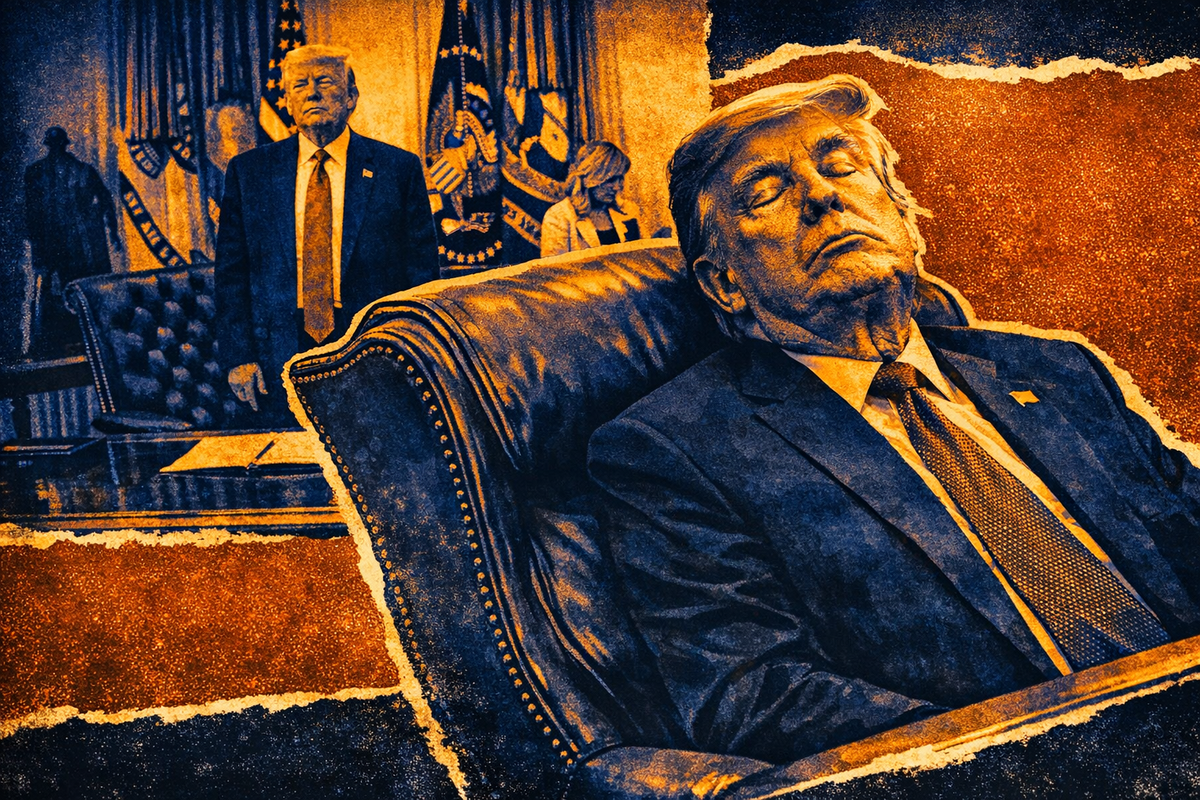
Eyes closed at the Resolute Desk. On November 6, during what was supposed to be a routine White House event about GLP‑1 medication pricing, cameras captured the president slumped at the desk, eyes closed for a sustained stretch while Dr. Mehmet Oz spoke. Within minutes, the clip ricocheted across social media, quickly earning the nickname “Dozy Don.” The moment might have been written off as a bad afternoon were it not for what happened next: a guest behind the president suddenly collapsed. Dr. Oz and aides moved fast to assist, though not as fast as RFK Jr., who bolted from the room as though he’d just heard someone say ‘WiFi activated mRNA’. RFK Jr.’s exit quickly became a meme in its own right, with social media riffing on his well-known skepticism about vaccines and wireless technology. The surreal scene only added to the viral momentum, amplifying the sense that this was no ordinary White House event.
After the press pool was ushered out, the president’s response, visible from multiple angles, was bizarre: a slow stand, a blank stare, and then a glance back toward the cameras before the feed cut. It looked as if he were waiting for someone to say “cut,” but that cue never came. Watching the video, it’s hard not to see a confused elderly man who simply didn’t know where he was or what was happening. When reporters returned, the official line was that the guest was “fine,” and the show went on (WaPo video | People | The New Republic).
Daytime dozing at the domestic table. Just two weeks earlier, cameras captured the president at a White House meeting, head dipping as an adviser offered extended praise in what has become a strange White House ritual. The president’s attention returned only when prompted by name. Many have called out the hypocrisy—Trump and his allies have long labeled Biden “Sleepy Joe,” yet it’s Trump who now seems unable to stay awake, even on television, in his second term. But that’s not the real issue. These moments aren’t just fodder for late-night jokes—they’re now a regular feature in political reporting, raising serious questions about stamina and focus at the heart of executive decision-making (Atlanta Black Star).
Please, just a moment of your time...
Liberty’s Lens is entirely reader‑supported. We don’t answer to corporate masters deciding what we say or what we cover.
If you find our work valuable, please consider upgrading to a paid subscription. You can take 20% off with this coupon — and support independent media for about the price of a coffee per month.
If you've been thinking about upgrading to paid to support the work of Liberty's Lens, now is the time. Upgrade and save.
If a subscription isn't in the budget right now, a one time contribution, any amount, is always appreciated.
Thank you to every reader who shares our work and helps it reach new audiences. We couldn’t do this without you. We love you all.
Foreign stage
Guided in Tokyo. At Japan’s October 28 Guard of Honor ceremony, Donald Trump’s performance became a viral metaphor for disorientation on the world stage. While Japanese Prime Minister Sanae Takaichi paused at the flags as protocol dictated, Trump kept moving, seemingly oblivious to the ceremony’s structure. Video footage captured him saluting Japanese troops, then wandering off ahead of his host, forcing aides and soldiers to scramble in redirecting him. His posture was stiff, his steps slow and uneven, and his gaze unfocused—prompting the Japanese delegation to eventually abandon protocol and simply follow his lead back to the podium.
The scene quickly became fodder for social media, with many comparing Trump’s aimless walk to a “drunk Frankenstein’s Monster” and joking that even a blind bulldog would have shown more situational awareness. But beyond the humor, the symbolism was hard to ignore: a president who touts his command of respect from world leaders needed to be physically guided through a basic diplomatic ritual. The incident blurred the line between embarrassment and concern, fueling questions about the country’s image abroad and whether the most powerful office in the world is being led by someone increasingly out of step with the moment (Independent TV | Yahoo | BuzzFeed).
Laughter in Copenhagen. Earlier that month at the European Political Community summit in Copenhagen, a stray camera picked up Albania’s Edi Rama, Azerbaijan’s Ilham Aliyev, and France’s Emmanuel Macron chuckling over an imaginary “Albania–Azerbaijan” peace deal the president had boasted about. The exchange wasn’t an official readout; it was a candid signal from allies who do not believe Washington’s narrator is reliable right now (The Independent).
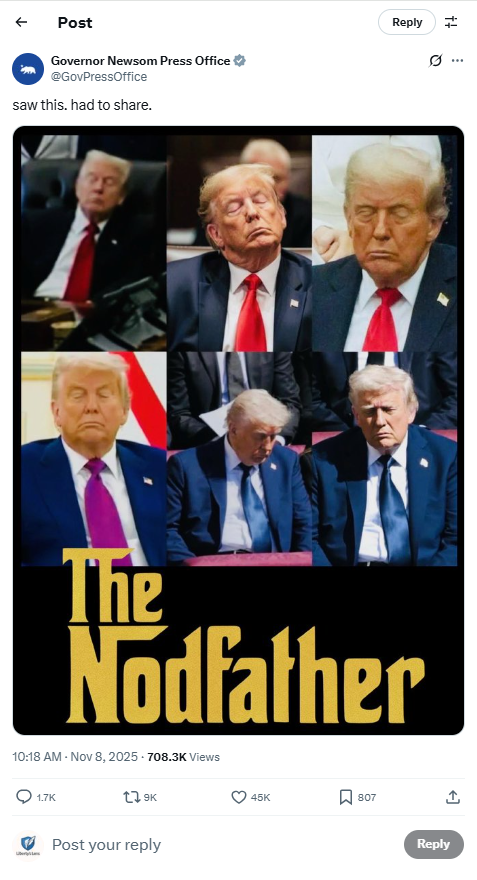
‘Dozy Don’ goes viral. Social media has amplified these moments with viral memes like “Sleepy Don,” “Mall Walker,” and “The Nodfather,” turning isolated incidents into a broader public perception of decline. These memes don’t just entertain, they shape the national conversation about leadership and accountability in the Oval Office. Outside of rightwing echo chambers, they’re spreading like wildfire, with major news outlets picking up on the trend after Gavin Newsom’s viral jabs. The result: millions of impressions, trending hashtags, and a meme-driven narrative that’s impossible to ignore (MEAWW | Times Now).
Speech patterns
UN word salad. The September 23 UN address included a meandering climate riff that careened from “strong borders” to the “amorphous shape” of the atmosphere. Even by the president’s loose rhetorical standards, it was the kind of passage that makes allies nervous and editors reach for the transcript (Factba.se transcript).