Duty to Warn: The Hidden Crisis Behind the Oval Office Door
Escalation, Paranoia, and the Price of Denial
Liberty’s Lens Investigative Series
A four-part deep dive into the vacuum of power and the agenda filling it.
Part I:
 Liberty's Lens
Part II:
 Liberty's Lens
Part III:
 Liberty's Lens
Part IV:
 Liberty's Lens
The President’s Recent Execution Posts
On November 20, the President of the United States didn’t just rage-post, he crossed a line that even his own party would once have called unthinkable. In a flurry of Truth Social blasts, Donald Trump accused six Democratic lawmakers of “SEDITIOUS BEHAVIOR” after they released a video reminding military and intelligence personnel that they are legally obligated to refuse unlawful orders (USA TODAY | CBS News).
The escalation was swift and chilling: from “LOCK THEM UP???” to an all-caps declaration, “SEDITIOUS BEHAVIOR, punishable by DEATH!” Within hours, Trump amplified posts calling for the lawmakers to be hanged, including one reading: “HANG THEM GEORGE WASHINGTON WOULD!!” (POLITICO | NBC News)
The targets of the president’s venom weren’t random. They were veterans and former intelligence officers—Sen. Elissa Slotkin, Sen. Mark Kelly, and Reps. Jason Crow, Chrissy Houlahan, Chris Deluzio, and Maggie Goodlander—lawmakers who know the chain of command and the Constitution. Their message was simple: “Our laws are clear: You can refuse illegal orders. No one has to carry out orders that violate the law or our Constitution.” (USA TODAY | The Independent)
The fallout was immediate. Capitol Police logged a surge in threats, including bomb scares and voicemails promising throat-slashing. Senate Minority Leader Chuck Schumer warned: “The president of the United States is calling for the execution of elected officials. This is deadly serious.” (The Hill | CBS News)
This isn’t just rhetoric. It’s symptomatic behavior under stress, a glimpse of what clinicians have been warning for years: when decline meets fear of losing control, the result isn’t restraint. It’s escalation.
The Health Question Isn’t Gossip, It’s Governance
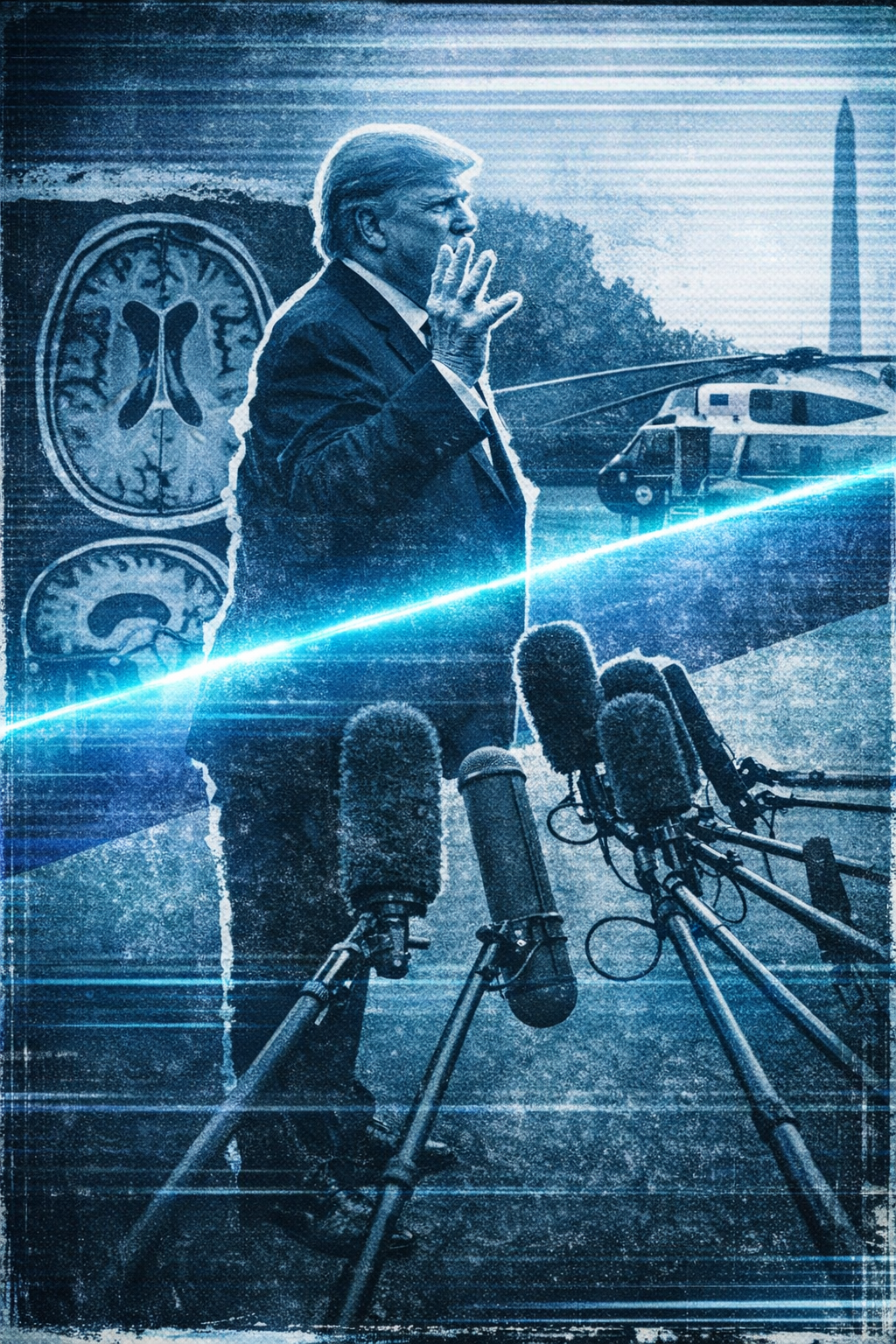
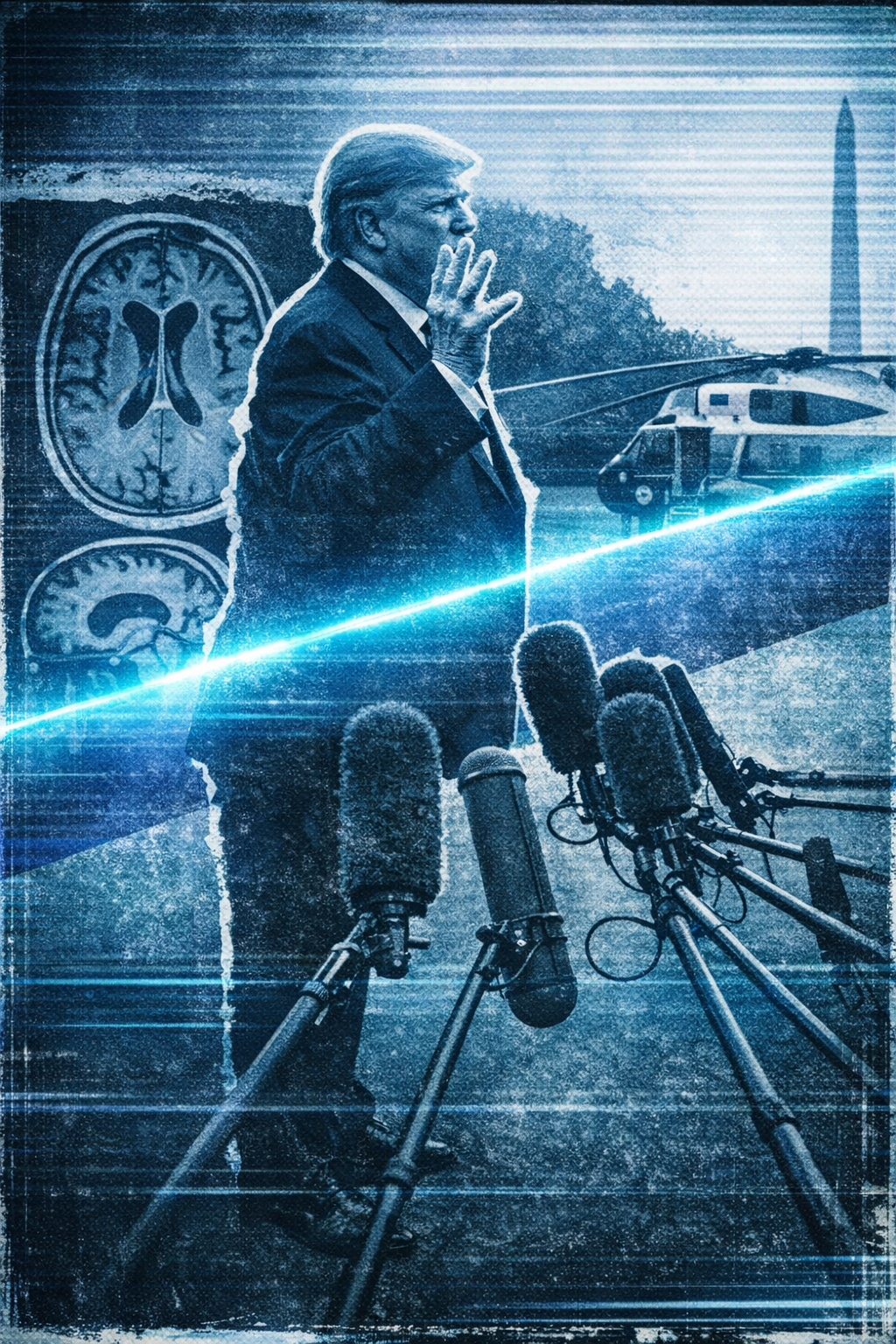
Yes, presidents age in public. Yes, gotchas are cheap. But the health story here isn’t rumor, it’s a timeline. Two physicals in six months. An MRI disclosed to reporters on Air Force One but never explained by staff. An increasingly stiff gait. Months of visible swelling around the ankles and bruising on the back of the hand, followed by a diagnosis of chronic venous insufficiency (The Insider | Express).
The through-line isn’t some banal diagnosis; it’s the persistent decision to reveal as little as possible about what plainly concerns allies and citizens. When the White House finally acknowledged the vascular condition, it did so only after weeks of speculation and visible decline. Even then, the explanation raised more questions than it answered: Why the secrecy? Why the sudden clustering of tests? Why the evasive language about “routine monitoring” when the president’s mobility and stamina have visibly changed?
This isn’t about voyeurism. It’s about transparency in governance. A president’s health isn’t a private matter when it intersects with national security, continuity of government, and the ability to execute constitutional duties. In this case, the pattern of concealment is as alarming as the symptoms themselves. And when a White House once claimed a man of Trump’s build was 6’3” and 239 pounds, just shy of the obesity threshold, it’s hard to credit anything they say about his health.
Please, just a moment of your time...
Liberty’s Lens is entirely reader‑supported. We don’t answer to corporate masters deciding what we say or what we cover.
If you find our work valuable, please consider upgrading to a paid subscription. You can take 20% off with this coupon — and support independent media for about the price of a coffee per month.
If you've been thinking about upgrading to paid to support the work of Liberty's Lens, now is the time. Upgrade and save.
If a subscription isn't in the budget right now, a one time contribution, any amount, is always appreciated.
Thank you to every reader who shares our work and helps it reach new audiences. We couldn’t do this without you. We love you all.
Enter Duty to Warn: What Clinicians See
“Duty to warn” is an ethical principle rooted in the idea that when someone poses a foreseeable risk of harm, silence is complicity. For Dr. Bandy X. Lee, the former Yale psychiatrist who edited The Dangerous Case of Donald Trump, that duty didn’t end when Trump left office the first time. In fact, she says the danger has only grown (Daily Beast Podcast | Business Times).
Lee’s warnings in recent interviews are blunt: “He’s paranoid.” “The more power he gains, the worse his paranoia becomes.” She points to Trump’s demand for loyalty tests, his accumulation of ICE agents as a quasi-police force, and his insistence that states deploy National Guard units as “guards for himself against the people.” These aren’t policy preferences, Lee argues—they’re symptoms. “When Trump demands this kind of powerful positioning of himself, he’s doing so from a place of pathology. It’s not a healthy demand.” (Inquisitr)
“He’s now accumulating ICE agents as government police forces; he’s now required every state to deploy 500 National Guard members to function essentially as a guard for himself against the people.”
— Dr. Bandy X. Lee, Daily Beast Podcast, Nov 2025
Her framework is simple but chilling: paranoia plus insecurity plus power equals escalation. And escalation isn’t hypothetical, it’s happening in real time. The Truth Social posts fantasizing about executing lawmakers? Lee calls that textbook behavior for a declining, dangerous personality under stress (Daily Beast Clips). The recent dangerous dismantling of nuclear agreements? Another sign of impaired judgment.
“We cannot forget what initially instigated the current threats of nuclear war: the first Trump administration’s “first nuclear strike” policies, the pulling out of the Iran nuclear deal, and the emboldening of global aggressors with nuclear power, such as Russia and Israel—far before any attack.” — Bandy X. Lee
Lee isn’t alone. Former Johns Hopkins professor John Gartner (Dr. John Gartner's Substack) warns that Trump’s cognitive collapse is layered onto malignant narcissism, a “toxic mix” that will only get worse: “He used to speak with a high level of vocabulary in very polished paragraphs. Now… there are times when he’s really unable to complete a thought. Sometimes he’s unable to complete a word.” (The Week). Gartner predicts meltdowns in high-stakes settings and catastrophic decisions under pressure. Lance Dodes, a retired Harvard psychiatrist, calls the evidence of dementia “overwhelming” and says Trump meets the 25th Amendment standard for removal: “Dangerously unable to fulfill the responsibilities of office.” (Newsweek).
“It’s so impulsive and erratic, and this guy has the nuclear football. This is really someone who could wake up in a state of complete confusion and irritation and do something catastrophic. And no one is going to stop him.” — Dr. John Gartner, Raw Story, Oct 2025
Across these voices, the consensus is clear: decline doesn’t just show up in video clips of Trump wandering into weird tangents and losing his train of thought—it shows up in behavior, in policy, and in the corrosion of constitutional norms. And the trajectory isn’t toward stability. It’s toward acceleration.
“He’s making up endings of words he can’t remember, jumping between topics like a stone skipping across water.” — Dr. John Gartner, Raw Story, Oct 2025