Do as I Say or the Economy Gets It: Trump’s DHS Chief Threatens Economic Fallout Over ICE Cooperation
As Trump’s DHS eyes airport closures, are we seeing the consequences of governing through chaos?
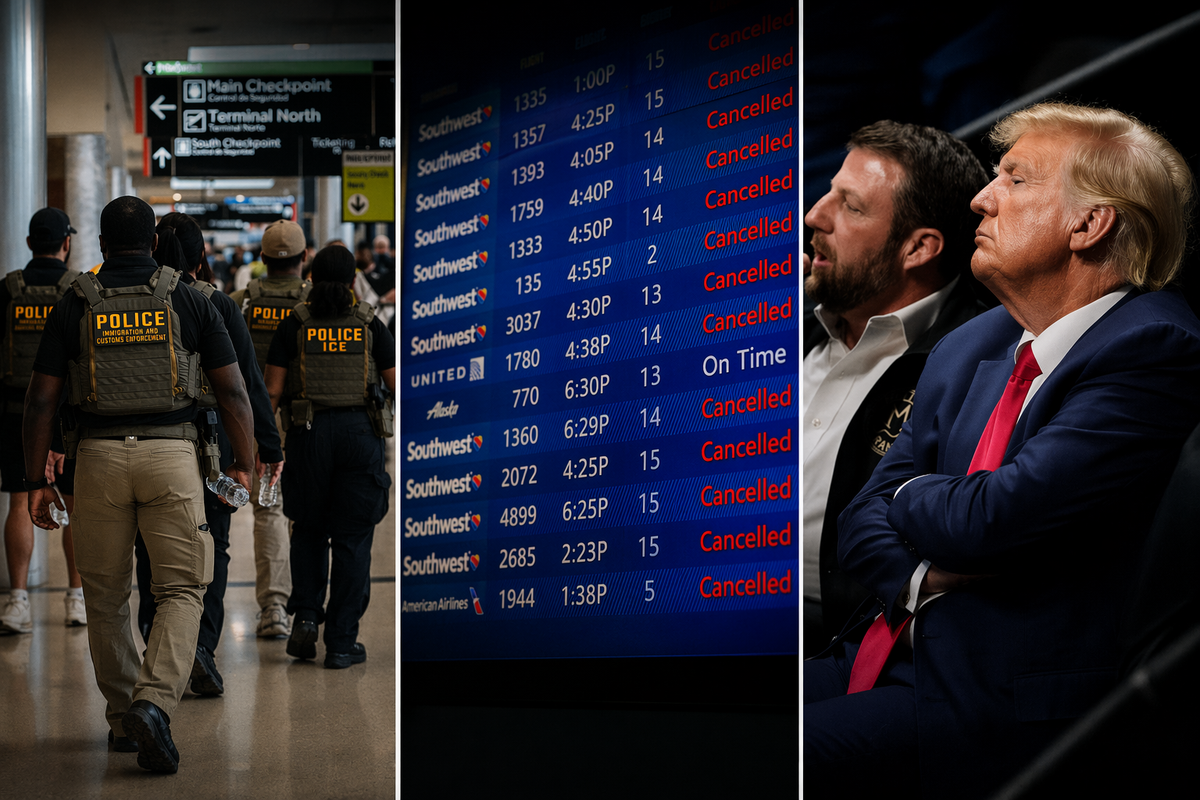
Homeland Security Secretary Markwayne Mullin is considering a plan to stop processing international flights at airports in so‑called “sanctuary jurisdictions” by pulling Customs and Border Protection officers from those hubs. Removing CBP agents from major international airports “would cause immediate and lasting harm,” the U.S. Travel Association warned, while Airlines for America said it could have a “devastating effect” on airline operations, tourism, and the flow of global cargo.
Because federal law requires international passengers to clear customs when they land, pulling CBP resources effectively shuts those airports down for global travel. Flights don’t just redirect cleanly to other cities, and passengers don’t casually accept being dropped hundreds of miles from where they intended to go. The system doesn’t bend—it breaks. Routes get canceled, hubs lose international connectivity, and entire regions take a hit.
Even within the administration, there’s skepticism. Transportation Secretary Sean Duffy has warned that the government “shouldn’t shut down air travel in a state that doesn’t agree with our politics.” Industry groups have been even more direct about the consequences.
But not everyone is hedging. Senator Jim Banks (R‑Indiana) has openly embraced the plan—and spelled out its purpose. He calls it “a good idea to punish those cities,” and frames it as shifting economic activity toward red states like Indiana, Texas, and Florida.
Liberty’s Lens is entirely reader‑supported. We don’t answer to corporate masters deciding what we say or what we cover.
If you find our work valuable, please consider upgrading to a paid subscription. You can take 20% off with this coupon — and support independent media for about the price of a coffee per month.
Thank you to every reader who shares our work and helps it reach new audiences. We couldn’t do this without you. We love you all.
What this actually does
There’s no ambiguity there. This isn’t about agency resources—it’s leverage.
Mullin is holding a gun to the economy’s temple and threatening to pull the trigger if his demands aren’t met. You shut off international traffic and you’re not just making a political point, you’re hitting tourism, business travel, airline routes, hotel bookings, restaurants, and economic activity flowing into major global hubs—real economic activity gets drained out. And the damage doesn’t stay neatly inside the target. It spills onto airlines, workers, travelers, and even Republican voters in those regions who rely on the same infrastructure. It’s a blunt instrument, and it only works if it causes enough disruption to force compliance.
What’s worse, there is no indication that Democratic officials will be willing to overhaul immigration policy—much of it codified into state and local law—just to prevent Mullin from disrupting some of the busiest airports in the Western Hemisphere. Nor should they.
If the man directing the President’s mass deportation agenda is willing to hold the livelihoods of millions of Americans hostage to meet a promise to deport 1 million or more people a year, then the fallout rests squarely with him. Democrats are being cast as negotiators in a crisis entirely of Mullin’s making. The harm he is willing to cause should be judged against the goal he’s trying to accomplish—not shifted onto the people he’s attempting to coerce.
 Liberty's Lens
An economy under strain—and being pushed further
If the cruelty isn’t the point, they certainly aren’t trying to avoid it. This administration has increasingly shown a willingness to impose economic strain to get what it wants—through tariffs, the Iran‑driven energy shock, and immigration enforcement—while at the same time insisting that the strain either isn’t happening or can be dismissed because of who it affects. The harm is real, but it’s treated as invisible, or written off as something confined to “blue cities” or Democratic voters.
At the same time, they show no willingness to acknowledge the warning signs—even when they’re staring them in the face. Kevin Hassett has been making the rounds telling anyone who will listen that the economy is actually doing great because spending is still strong and GDPNow is running north of 4 percent. On the surface, those are real numbers—but the interpretation is where it falls apart. People are still spending, not because they’re flush or optimistic, but because they have to—the cost of gas, food, and rent keeps climbing—and they’re making it work by draining savings and leaning on credit.
The share of credit card balances at least 90 days past due rose to 13.12% in the first quarter, the highest level since the period immediately following the 2008 financial crisis. When asked about the trend, Hassett acknowledged that “we do see an increased stress” on credit cards, but quickly brushed it aside: “for the most part, delinquency is different from default… people are taking a little bit longer.”
He makes the case even more directly elsewhere: “people are spending more money on gas, but they’re also spending more on everything else. Not just groceries, but restaurants, and so on… I think that’s a sign you would see when people are optimistic about the future.”
But that interpretation doesn’t hold up. The savings rate is already very low, plunging from 5.5% to 2.6% in just 12 months. That means the cushion people rely on is getting thinner, even as more households fall behind on their credit cards. That’s not healthy demand—it’s what people mean when they talk about survival debt: borrowing just to stay even.
The Costs of Earlier Choices Are Still Unfolding
When you step back from the mechanics of spending, the broader signals look even worse. Consumer sentiment is at extreme lows, dropping to a final reading of 44.8 in the University of Michigan survey—the lowest level since it began in 1952. That puts sentiment below levels seen during the 2008 financial crisis, the COVID‑19 pandemic, and the aftermath of 9/11.
And then you look at what’s happening with food, and it gets harder to pretend everything is fine. You’ve got measurable increases in food insecurity—families skipping meals, leaning on food banks—and that’s happening at the same time policy changes are pushing people off assistance.
Recent analyses and government data show that over 3.5 million people have been removed from the Supplemental Nutrition Assistance Program (SNAP) following policy changes enacted under H.R. 1, commonly referred to as the “One Big Beautiful Bill Act.” The sweeping federal budget reconciliation law introduced roughly a 20% cut to SNAP, slashing federal funding by $156 billion to $187 billion over 10 years—the largest reduction in the program’s history.
Beyond those cuts, the law shifts significant financial and administrative burdens onto states, expands work requirements, and tightens waivers, with significant downstream effects.
State-level data shows these restrictions heavily impact families; for example, in states with available data, the number of participating children fell by over 700,000—accounting for nearly half of the total enrollment decline.
Costs are rising while support is shrinking—and that’s exactly how financial pressure turns into real hardship.
 Liberty's Lens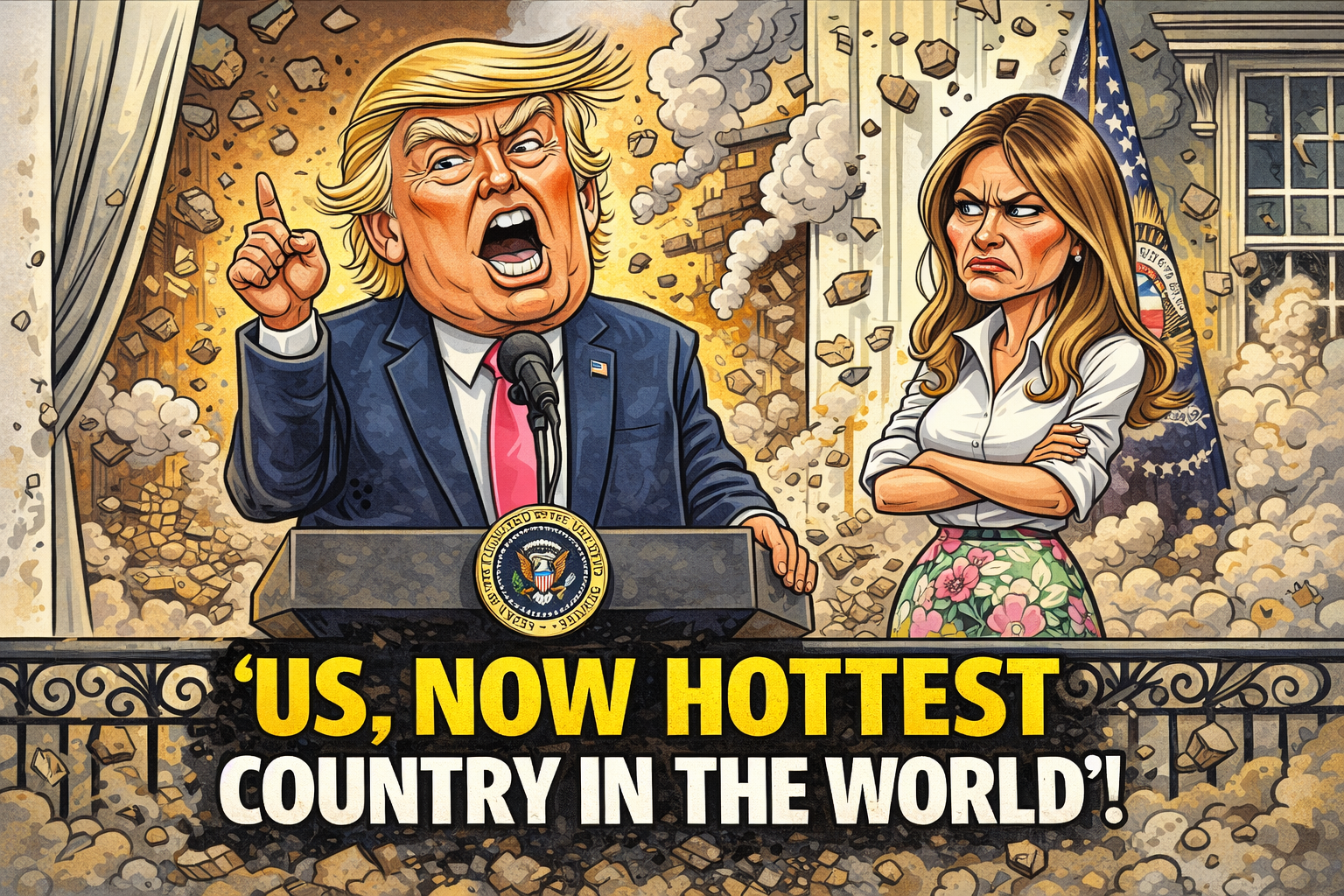
And they’re just getting started
What makes it worse is that a lot of the cost pressure hasn’t fully shown up yet. The energy shocks, higher fertilizer costs, and shipping constraints—driven by a war the President seems to be in no hurry to resolve—move with a lag. Farmers are already locked into higher input costs, and there isn’t much margin to absorb them—those costs are going to flow downstream to consumers. Even if the Strait of Hormuz opened tomorrow, those higher prices are still coming through the pipeline. So the inflation data you’re seeing now is backward-looking—it doesn’t reflect what’s about to hit.
Taken together, the rosy picture being sold to the American people doesn’t hold up. Trump’s chief economic adviser may be right about spending habits, but the available data suggests that this pattern is not sustainable. Households are stretched thin, relying more on credit and falling behind. And there’s additional pressure already baked in that hasn’t hit yet. The claim that everything is fine rests on numbers that are real, but misleading—used to obscure the harm already being felt.
All the while, the Trump administration prepares to impose more strain on an economy that’s already cracking—pushing past the warning signs to force forward its mass deportation agenda with no regard for the consequences.
Whether Mullin ultimately follows through is almost beside the point. Proposing a plan like this shows how far they’re willing to go.
Americans are already registering this strain in record‑low consumer sentiment. The question is whether those making these decisions are willing to listen.
The Trump regime’s authoritarian project depends on misinformation and disinformation. It thrives in darkness and resists scrutiny. That’s why exposure matters — and why independent media does too.
A free society depends on a free press. Not one shaped by access, intimidation, or political loyalty, but one willing to report what those in power would rather keep hidden.
Liberty’s Lens exists for that purpose. We’re independent, reader‑supported, and committed to reporting without fear or favor.
If that work matters to you, consider supporting it by subscribing — free or paid. Paid subscriptions directly fund our reporting, and right now you can subscribe at 20% off with this coupon, roughly the cost of a monthly coffee.
If a subscription isn’t workable at the moment, one‑time contributions are a meaningful alternative. And whether or not financial support is possible, sharing this work matters — it’s how reporting like this reaches people it would otherwise be kept from.
Your support keeps independent journalism alive.
Find us on X, Blue Sky, and Facebook. Wherever you are, that’s where we want to be.
— Liberty’s Lens
This article is provided for public interest reporting and analysis. All external links open in a new tab and point to their original publishers.
© 2026 Liberty’s Lens. All rights reserved.